Resurrected: Dr. Moretas
Video - Animation
Video further down below…
In our neighbourhood in Cork city, blackbirds are seemingly numerous and noticeably audible. One would think that these loud and flying dinosaurs weren’t going anywhere any time soon.
However, at the end of April I spotted a juvenile blackbird consistently sitting on a metal barrel in our garden. It either seemed like it didn’t want to flying or was too tired to fly. We giggled a bit about it at first from the comfort of the kitchen. When we’d open the door or approach the garden, the young animal would flap its wings a bit or jump down on the grass.
A protective adult male blackbird would scoot down to provide it with worms and attention once in a while, but the chick seemed to be quite demotivated. It would refuse to eat for most of the time too. I handed the blackbird guardian a few blueberries from Aldi for it to feed on, which it further tried sharing with the chick.
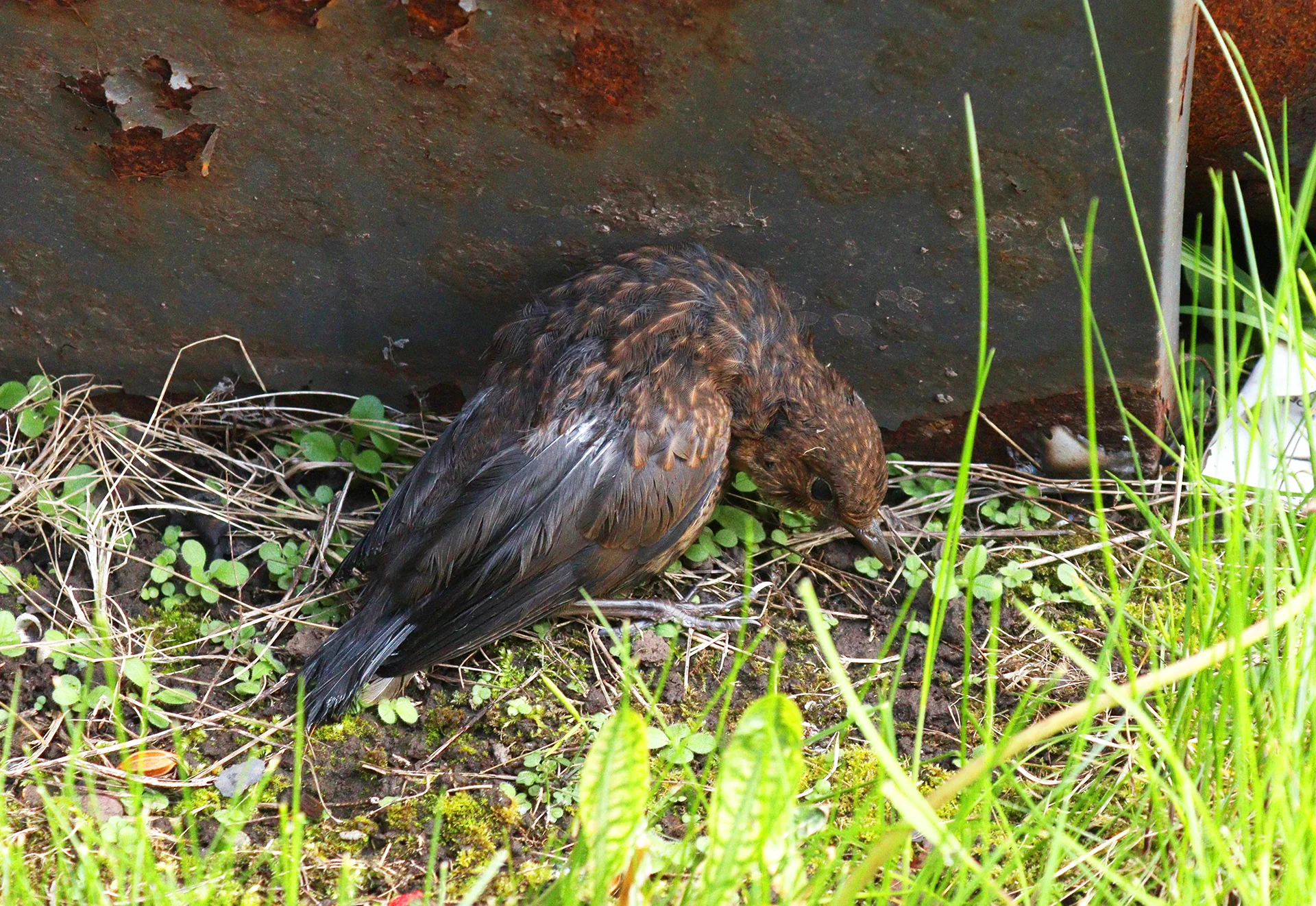
The next day, however, things looked grim. The juvenile blackbird had gone mostly docile. It was no longer able to stay on top of the barrel and was now on the ground next to it instead. More eerily, its neck was bent as if it didn’t have the strength to lift its head.
As I neared the ill dinosaur, I would hear high-pitched chirping from nearby frantic blackbirds. Staying around and donating a few more blueberries calmed down the dinosaurs a bit, and after a while, my presence wasn’t seen as intimidating. Occasionally, the guardian blackbird came down to try check on its chick.
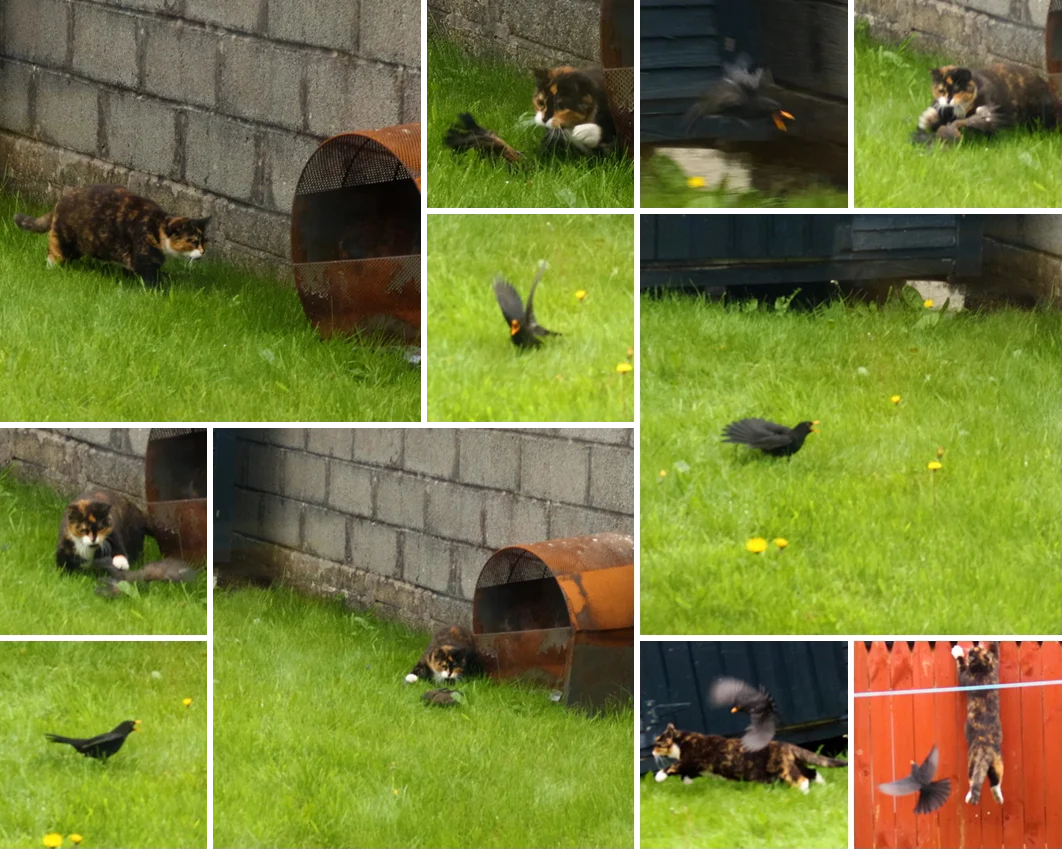
Eventually, a cat found its way to our garden. You can watch the video below to see how that panned out.
My initial thought was to let the cat kill the juvenile blackbird to end the suffering of the latter. However, seeing the ferocity of the pissed-off guardian was enough for me to join in on curbing the efforts of the cat! In retrospect, it was probably also good to avoid having the cat carry any diseases back to its owner.
The blackbird parent gave the cat some Velociraptor-energy; harkening prehistoric times when dinosaurs hunted mammals!
While the dinosaur managed to scare away the cat, the situation only deteriorated. The next day, I found the juvenile blackbird dead. With gloves and a plastic bag, I disposed of it in our compost bin; an unceremonious funeral for an animal that had likely spent its final moments miserably.
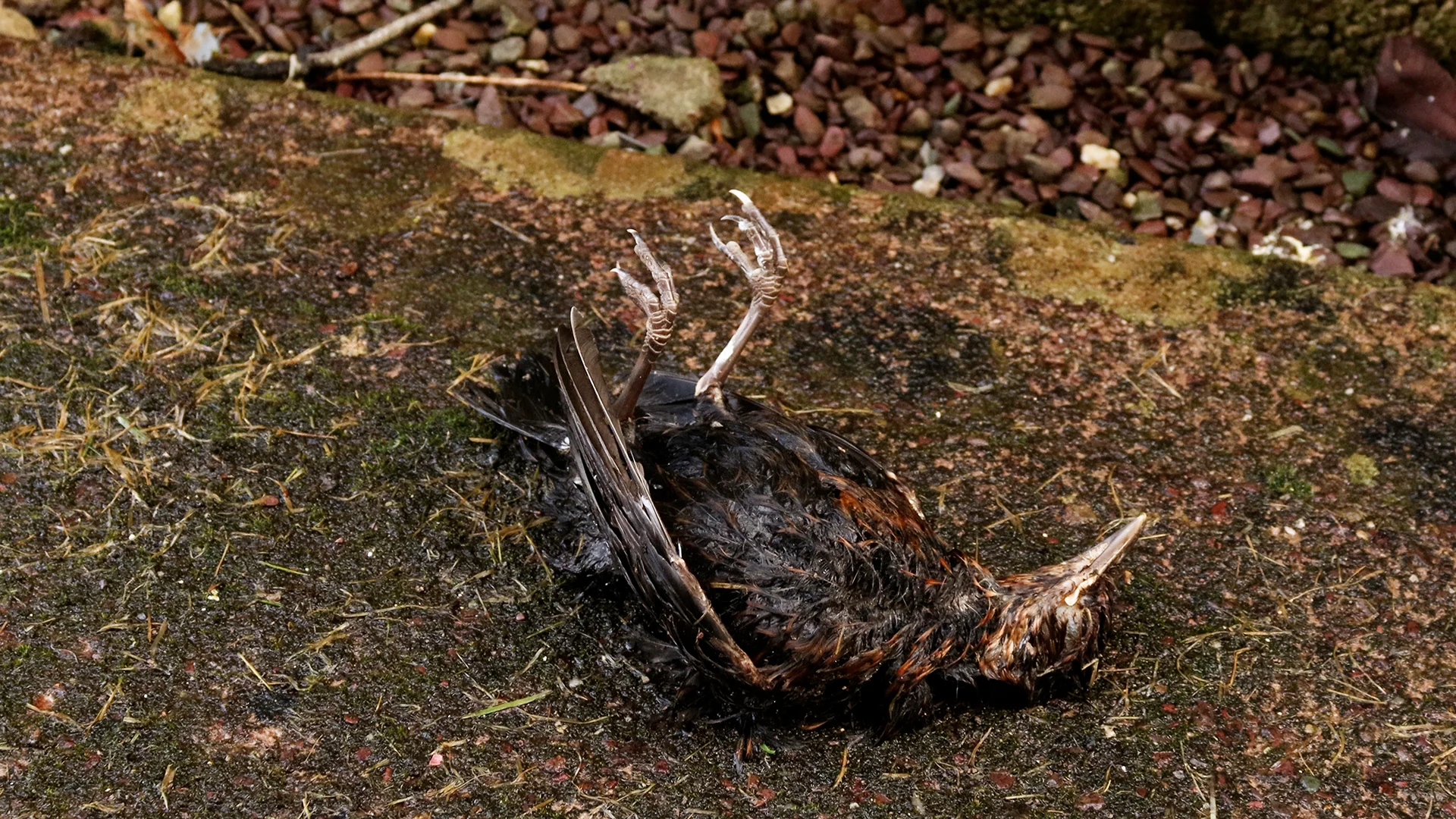
By the following morning after the scuffle, the juvenile blackbird had died. Its body is noticeably thin and its feathers ruffled with no sign of physical struggle.
There’s a deadly mosquito-carried virus going around the world that has infected and reduced blackbird populations in recent times. USUV or Orthoflavivirus has a high mortality rate for blackbirds in particular and can even infect and severely affect humans with suppressed immune systems.
The virus is more commonly referred to as Usutu, but I’m also conscious of how colonially and selectively pathologists have given many diseases Global South-referencing names (think ebola, monkeypox, Sudan-virus, West Nile-virus etc. etc).
I’m not a pathologist in any way, but the symptoms I spotted in the blackbird were very reminiscent of those describing USUV in blackbirds by various papers and articles:
I mentioned this in a chat with other environmentally keen people, and one said that he had observed a similar example in Cobh. In an area in London, populations were shown to have reduced about 50% from 2020, and it was first reported in Scotland this April 2026.
The spread of this disease via certain species of mosquitoes has, surprise-surprise, been linked to climate change.
An iconic bird that we might consider ubiquitous, but could perhaps be more uncommon in the nearest future.
References:
Agliani, G., Visser, I., Marshall, E. M., Giglia, G., de Bruin, E., Verstappen, R., van Mastrigt, T., Chandler, F., Sikkema, R., van der Jeugd, H., Koopmans, M. P. G., Gröne, A., Rockx, B. & van den Brand, J. M. A. 2025. Experimental Usutu virus infection in Eurasian blackbirds (Turdus merula). npj Viruses Vol. 3, 51. DOI: 10.1038/s44298-025-00133-w.
Gelskov, L. V., Johnston, C. M., Hammer A. S. V., Jensen, T. K., Lohse, L., Belsham G. J., Rasmussen T. B. & Olesen, A. S. 2024. First detection of Usutu virus in wild birds in Denmark. Scientific Reports. Vol. 16, 5156. DOI: 10.1038/s41598-026-35874-y.
Olupot-Olupot, P., Mulongo, M., Taylor-Robinson S., D., Bwire, G. & Okware S. 2025. Reconsidering Ebola virus nomenclature: a call for a stigma-free and precise terminology. The Lancet Global Health. Vol. 13, Issue 6. PP. e981-e982. DOI: 10.1016/S2214-109X(25)00139-1.
Pilgrim, J., Metelmann, S., Widlake, E., Seechurn, N., Vaux, A., Mansfield, K. L., Tanianis-Hughes, J., Sherlock, K., Johnson, N., Medlock, J., Baylis, M. & Blagrove, M. S.C. 2024. UK mosquitoes are competent to transmit Usutu virus at native temperatures. One Health, Vol. 19. DOI: 10.1016/j.onehlt.2024.100916.
https://www.rhs.org.uk/wildlife/blackbird-usutu-virus
https://www.gov.uk/government/news/first-detection-of-usutu-virus-in-scotland
https://www.galwaybeo.ie/news/galway-gardeners-urged-watch-out-10213053
https://www.standard.co.uk/news/london/blackbirds-numbers-fall-mosquito-virus-usutu-b1208062.html

Thomas Heising here!
I’m originally from Denmark, but now living in Cork, Ireland and working with visual science communication. You may have found this post because you were curious about this page or wanted to know more about the topic at hand – in any case: welcome.
There are more writings, visuals and videos around here about geology, the weather, our planet, Ireland, Denmark and other things that interest me.