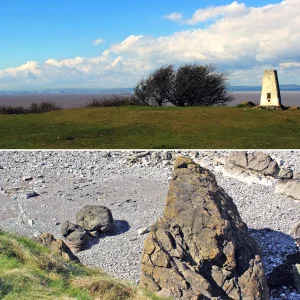
Pillow lavas in Somerset
Geology nugget

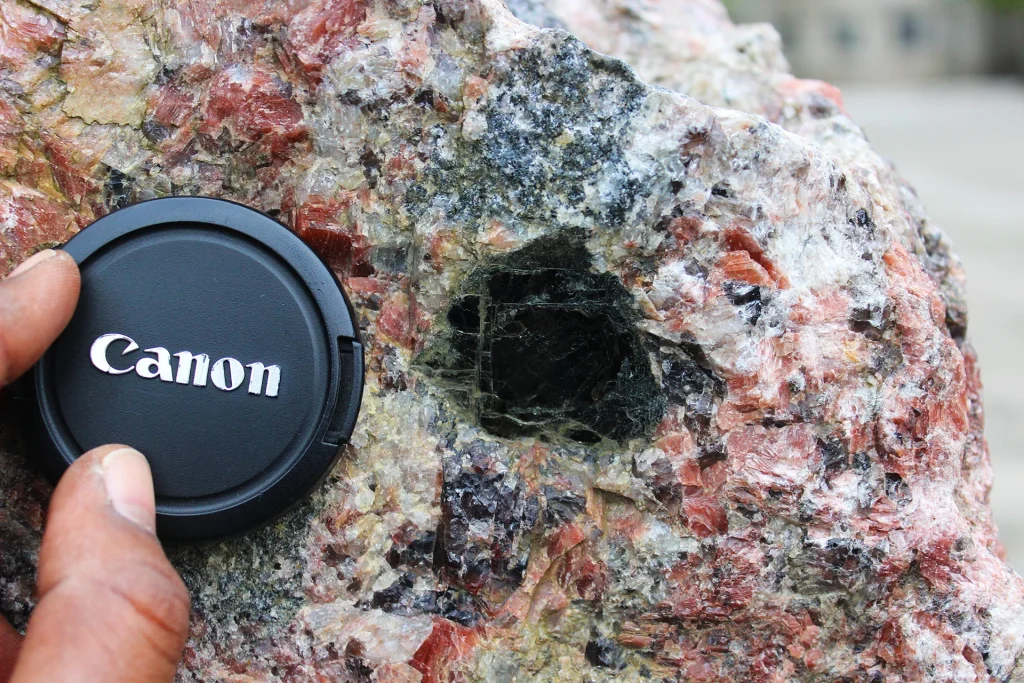
These dark minerals are called amphiboles. They can be discerned from the equally dark mineral biotite as the amphiboles are much harder.
These red minerals are potassium feldspars. They’re some of the most common minerals in our crust.
This large black grain is a piece of biotite – a mineral that forms as a granitic magma evolves through the crust. Biotite looks a bit like flimsy plastic and is part of the same mineral group micas that the similar, but white or transparent mineral muscovite belongs to.
The brightest of minerals on granites are typically quartz. However, these can inherit colour from minerals or chemical elements mixing in with the chemistry and crystal structure of the quartz-minerals.
A late arrival to the mineral festivities after the granite crystallises is chlorite. This is the green stuff seen giving the granite patches of vomit-tinted texture. Chlorite often accompanies biotite and comes about after the granite has formed.
Let’s talk granites!
Danish politicians are often paranoid and self-victimising. In an attempt at “terrorsikre” (terror attack protecting?) the parliament building Christiansborg, they set up a semi-circle of roughly cut granite boulders near one of the entrances. Apparently, this was to avoid potential angry terrorists driving trucks into the building (?)… Yes, that is the official explanation.
Moral of the story? I don’t know. Maybe don’t undermine social cohesion and participate in genocidal colonial enterprises with the US?
Anyways, granites!
As a silver lining in all of this silliness, the freshly-cut granite boulders yielded excellent opportunities to study exemplary granite features. I have highlighted these with little white points that you can interact with in the image above.
Granites are formed a few kilometres below our feet as crust material melts or mixes with existing magmas. The rich material from the crust yields silica-rich magmas that we then call granitic magmas.
Bornholm, which is a Danish island that is officially Danish but geologically Swedish, has some of the most beautiful assemblages of granites I’ve ever seen.
I did a geological guide of Copenhagen if you want to explore these for yourself.
References:
Morad S., Sirat M., El-Ghali M.A.K. & Mansurbeg H. 2011. Chloritization in Proterozoic granite from the Äspö Laboratory, southeastern Sweden: record of hydrothermal alterations and implications for nuclear waste storage. Clay Minerals. Vol. 46 (3). PP. 495-513. DOI: 10.1180/claymin.2011.046.3.495
Cao, R., Chen, D-F., Gu, H-D., Chen, B., & Yan, S-C. 2022. Mineralogical Characteristics of Biotite and Chlorite in Zuluhong Polymetallic Deposit: Implications for Petrogenesis and Paragenesis Mechanisms of the Tungsten and Copper. Minerals. Vol 12(10), 1280. DOI: 10.3390/min12101280