A grand knight
Geology nugget
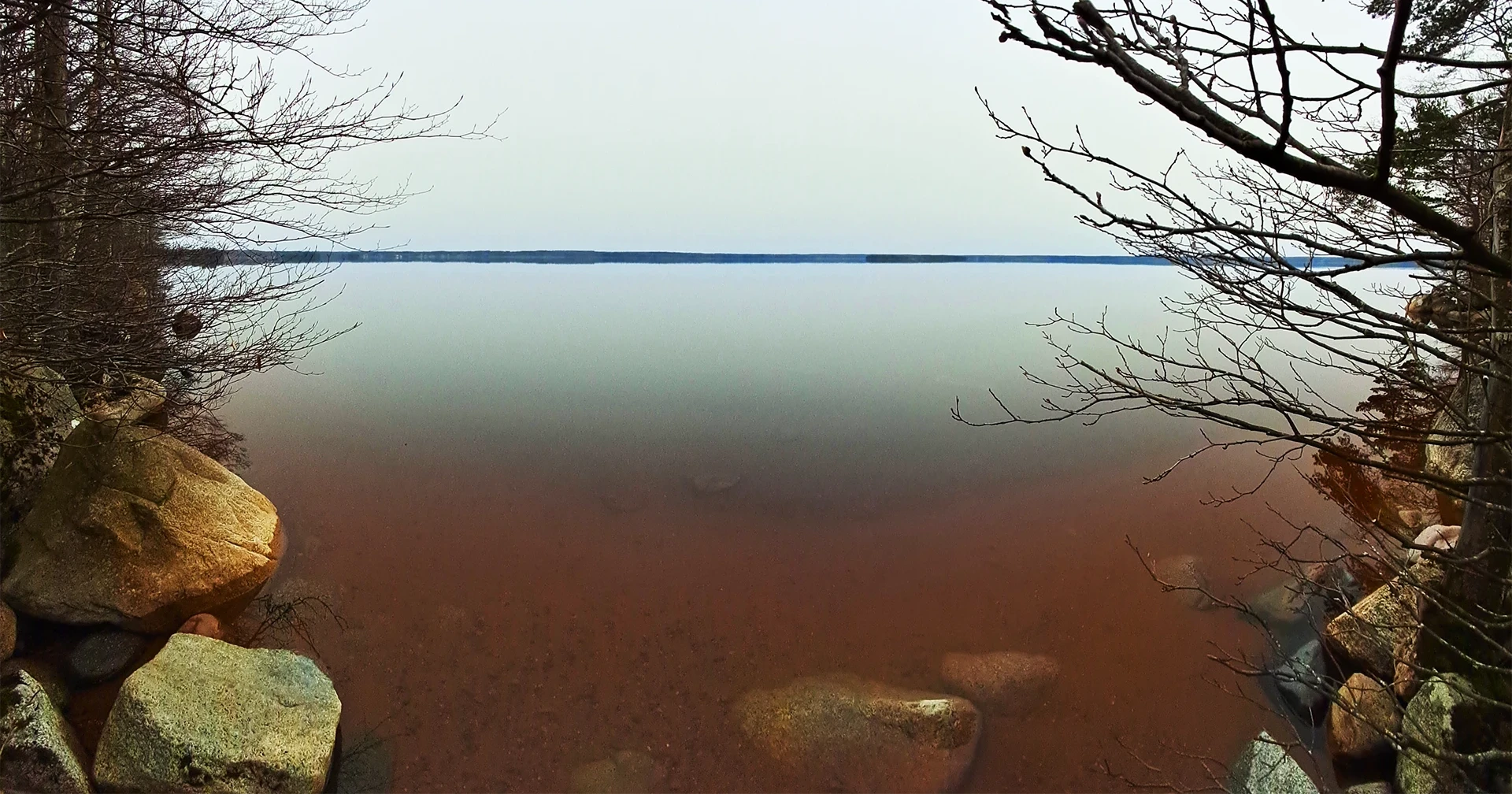
My family and I have visited Southern Sweden an unknown number of times over the years, since it’s an easy enough trip from Copenhagen, and there’s a lot more natural scenery than in Denmark.
Beyond the flora and fauna, here’s a cool spot north of the harbour town Karlshamn that I get a small tingle out of visiting…
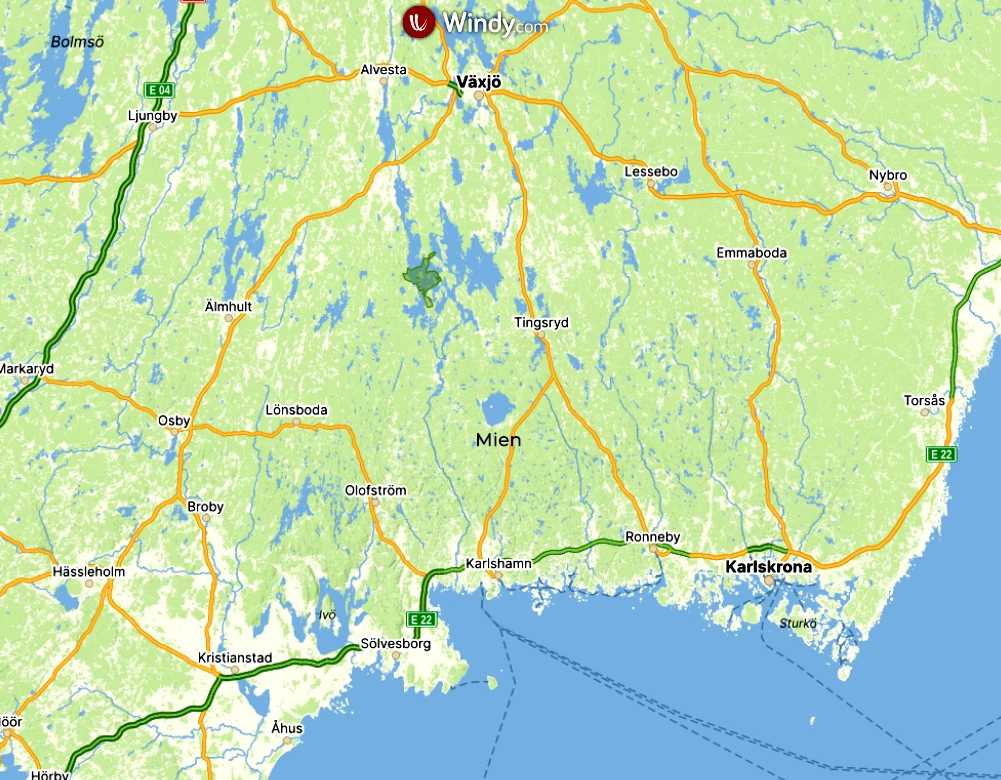
The oddly circular shape of Lake Mien was a puzzling feature even before its origins as an “impact structure” were finally understood. Map from windy.com and mapy.com.
An impact structure is a fancy term describing a scar on a planet’s surface after a meteor, asteroid or another large space-derived object has struck said planet.
You could call it a “crater” as well, but a crater can also apply to a circular mark left after a terrestrial event such as an explosion or a volcanic eruption.
The impact structure that created today’s Lake Mien came about 120 million years ago. In case, you’re wondering, yes, large non-bird dinosaurs were around at that time. Moreover, South America and Africa were still one coherent landmass at the time, and so were Madagascar and India.
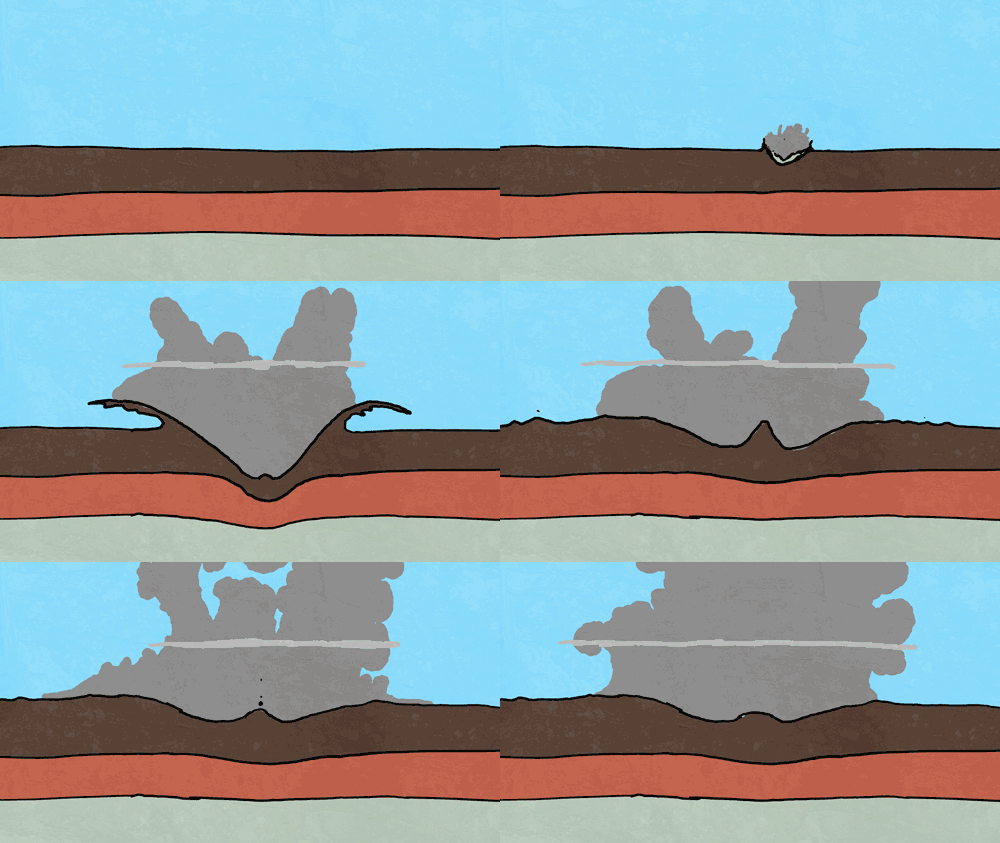
Animated the above specifically for this little post.
Today, Mien, sjön Mien or Lake Mien is slightly over 6 kilometres across at its widest and mostly covered by water – hence a lake.
Even from satellite imagery, the shape of Mien stands out. Though many lakes around the world are circular in shape, it wasn’t seriously speculated up until the 1960s that the lake might be a meteor crater.
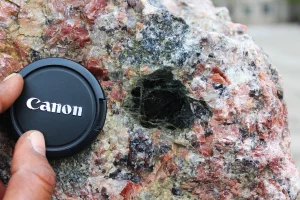
Loads of evidence has since been uncovered pointing to Mien’s catastrophic origin. The more or less homogeneously granitic bedrock is interrupted by breccias (rocks with angular “shattered” rock fragments cemented together), minerals like shock quartz that show signs of having been instantly transformed under high temperatures and pressure, and surrounding bedrock that has undergone rapid melting.
As the meteor would’ve struck, the impacted bedrock would’ve melted immediately and flowed like a liquid!

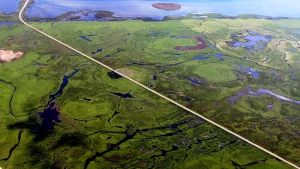
Spacey behaviour at the rim of an impact structure AND a moose sanctuary.
Shooting stars that you may glimpse at night are also meteors – rocks or assemblages of rocks that come drifting in from space before hitting our planet at high speeds. The reason why they streak glowingly on the sky is due to them heating up and disintegrating in our atmosphere.
If you look at the Moon, you’ll see loads of craters across its surface. By rights, Earth should look like that too, but currently doesn’t. This is due to a combination of the Moon taking a plenty for the team, our weather and moving landmasses cleaning up evidence of past impact structures, and our planet having an atmosphere. Besides making sure we can breathe, as a bonus feature to our subscription of air, we have a meteor firewall!
Small meteors travelling through the atmosphere accumulate air in front of them and start heating up. At some point, they simply disintegrate colliding with the air.
Yet, this shield is insufficient when larger, kilometre-sized and, luckily, much rarer objects enter into our atmosphere like what happened in “Sweden” 120 million years ago.
References:
Ferrière, L., Koeberl, C. & Reimold, W. U. 2009. Characterisation of ballen quartz and cristobalite in impact breccias: new observations and constraints on ballen formation. European Journal of Mineralogy, Vol. 21, PP. 203–217. DOI: 10.1127/0935-1221/2009/0021-1898
Holm-Alwmark, S. 2021. Impact cratering record of Sweden—A review. Large Meteorite Impacts and Planetary Evolution VI, Vol. 550, PP. 1-39. DOI: 10.1130/2021.2550(01)
Kenny, M. H., G. G., Martell, J., Whitehouse, M. J., and Alwmark, C. 2024. The first U–Pb age for shocked zircon from the Mien impact structure, Sweden, and implications for metamictization-induced zircon texture formed during impact events. Meteoritics & Planetary Science 59, Nr 1, PP. 211–241. DOI: 10.1111/maps.14116
https://apps.sgu.se/kartvisare/kartvisare-berg-50-250-tusen.html