Thomas Heising

Visual science communication
Back to the Lab

Soviet Mine or West Cork?

Video - Geology nugget
2024 | Svalbard, Norway
Timecodes for the video:
  • 0;00: Arrival from Billefjorden.
  • 0;12: An Arctic fox.
  • 0;16: Disused common areas.
  • 0;19: Fantastic view towards Nordenskiöldsbreen.
  • 0;18: Down towards Longyearbreen.
  • 0;27: Pyramiden.
  • 0;28: Statue of Vladimir Lenin.
  • 0;30: “Peace” written in Ukrainian, Russian and English.
  • 0;33: Swimming pool as part of the sports hall.
  • 0;43: Time to leave.
Why go to West Cork and see Old Red Sandstone-rocks when you can go to Svalbard and see the same?
 
Obviously the benefits of studying them in Svalbard is that there’s less vegetation, lichen growth and soil, thus greater chances of finding traces of exotic plants and animals from an unfathomably distant bygone time. The benefits of studying these rocks in Cork are less worries about polar bears, money, hypothermia and carbon emissions.
 
Not only are there plenty of fossils of Devonian-Carboniferous life found on Svalbard – some of the same fossilised life became the foundation for the mining industry at the settlement Pyramiden.
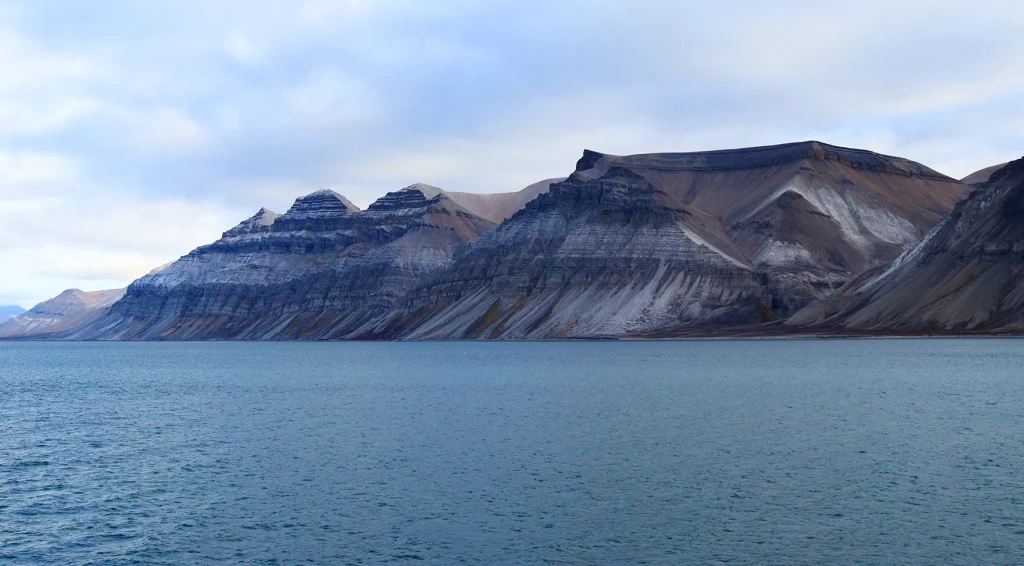
Gipshuken, Cowantoppen and Brisingefjellet along Billefjorden
Gipshuken, Cowantoppen and Brisingefjellet along Billefjorden are mostly made up of rocks from the Permian age.
Around 360-million-year old forests consisting of strange-looking plants all died; then got buried, heated and compressed over millions of years finally becoming layers of coal. That coal became the basis for the mining settlement of Pyramiden. Despite Soviet and eventually Russian ownership, the name is Norwegian, meaning The Pyramid, as you might’ve guessed – the nearby mountain narrowly resembling such a structure.
 
There’s an informative page here about the human history of Pyramiden, and how the mining town became a microcosm of Soviet living and society. It seems that people here lived culturally rich lives and that it was for a period seen as a good opportunity to work as a miner at Pyramiden. The end to this industry followed a series of dramatic events – geopolitically and locally.
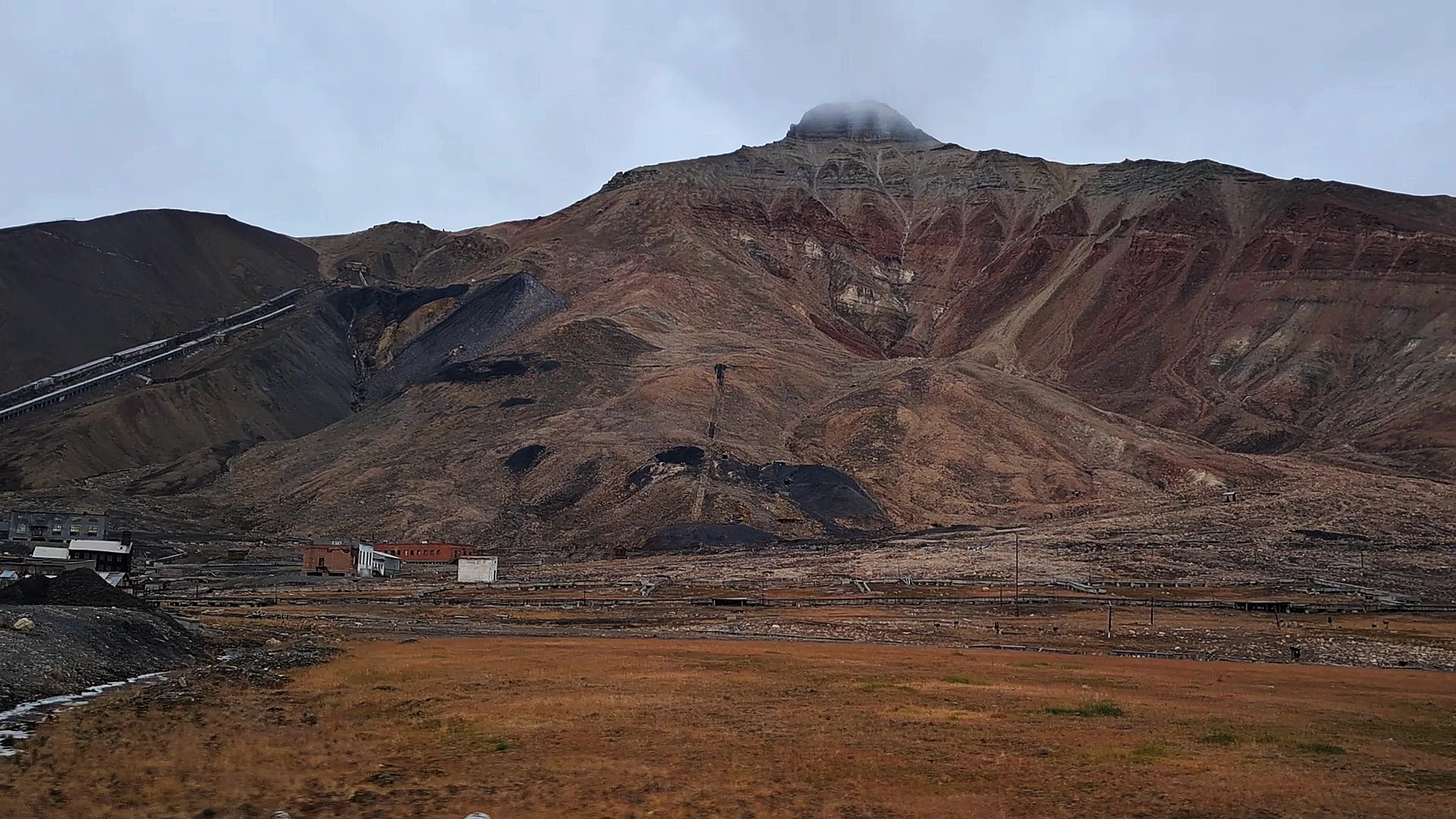
The mountain of Pyramiden on Svalbard with the coal mine to the left
Pyramiden is a bit of a geological mess. The darker rocks on the left side are the Devonian ones. As you go from left and right/upwards, you’re travelling forward in time – going from the Devonian to Middle Carboniferous and then Early Permian. Actually, no, there’s also a slice of even older bedrock thrown in. So don’t think too much about it…
However, as mentioned the geology is also interesting. Svalbard was like Cork and Kerry in Ireland part of the Old Red Sandstone-continent. It’s from these rock layers that we find traces of the earliest forests and land-living vertebrates.
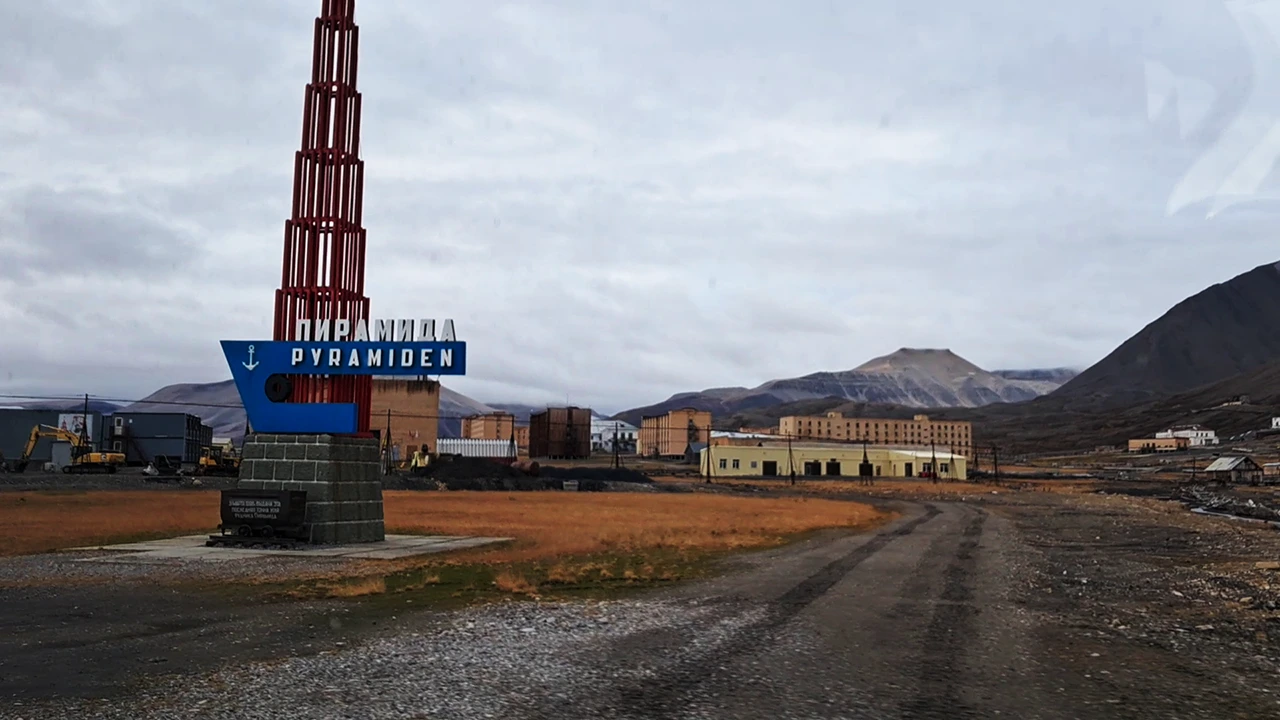
Pyramiden on Svalbard
But it’s also by using exactly these findings that the earliest modern thoughts about moving continents were made. Alfred Wegener was a German researcher who had noticed the abundant plants fossils on Svalbard. Looking at these in the 1910s, he surmised correctly that Svalbard originally was much further south than it is today. As such, he came to the conclusion that landmasses might’ve moved. His idea wasn’t well-received however.
 
The idea that continents are moving wasn’t accepted until later in the 1960s with what we now know as plate tectonics. Wegener was unfortunately dead by then.
 
Indeed, you can learn a lot from plant fossils. Unfortunately, I didn’t find any around Pyramiden, and we had to stick close together to avoid polar bear encounters without a guide present.
Most northerly shot at Pyramiden on Svalbard
Allegedly the most northerly alcoholic shot, however, I’m sure that the Russians in Franz Josef Land have invented their own shot at this point.
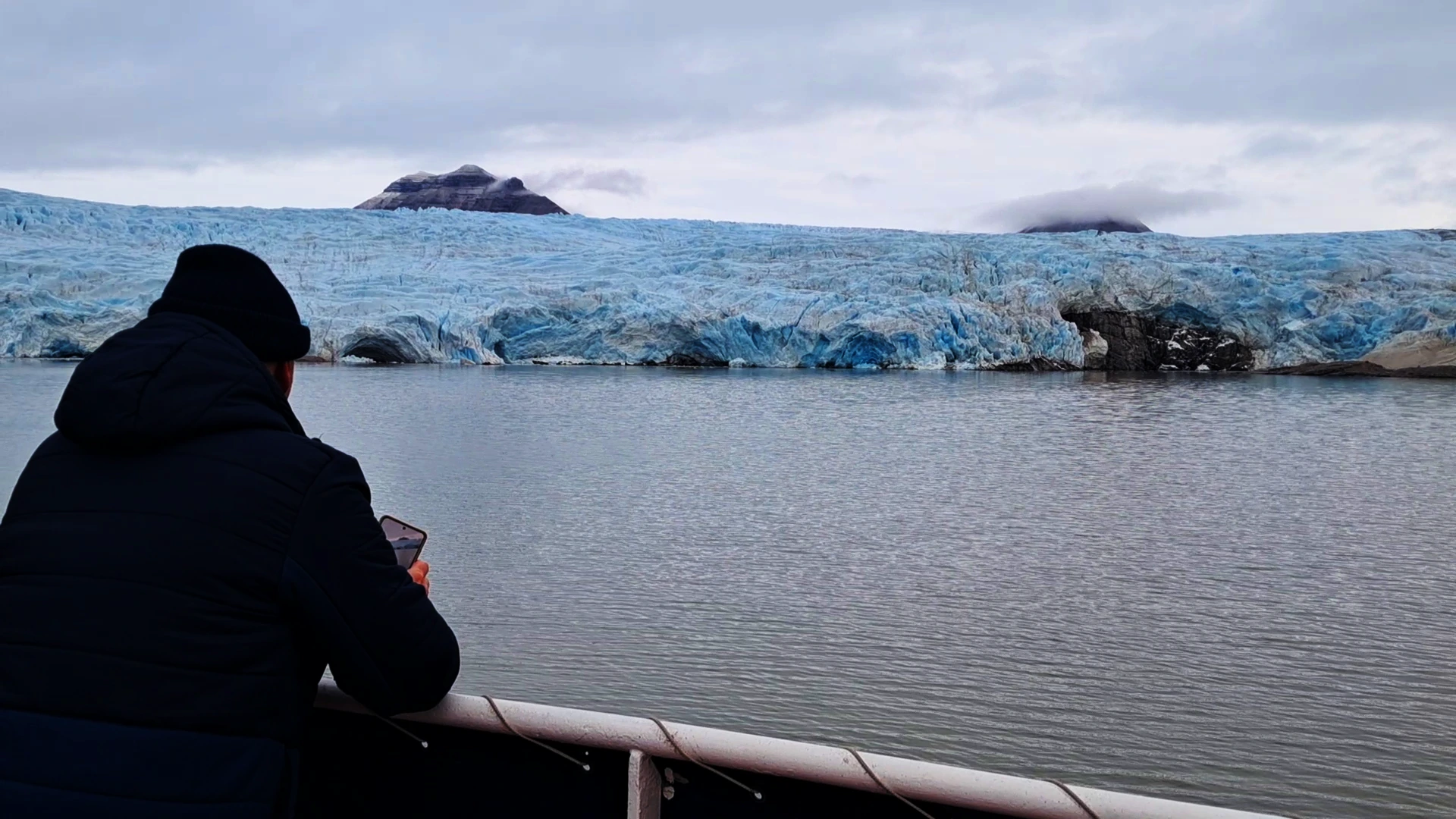
Also, the glacier Nordenskiöldbreen was epic. No pictures can do it justice. Last time, I was near such a thing was in Greenland many years ago. That was the Russell Glacier near Kangerlussuaq and we got even closer to that one. But I was an indifferent and self-obsessed teenager back then, so it didn’t thrill me as much as it should’ve. Perhaps, I knew that Quaternary geology wasn’t my thing.
Nordenskiöld Glacier

References:

https://geokart.npolar.no

https://allthatsinteresting.com/pyramiden

https://education.nationalgeographic.org/ resource/continental-drift

Berry C. M. & Marshall J. E. A. 2015. Lycopsid forests in the early Late Devonian paleoequatorial zone of Svalbard. Geology. Vol. 43 (12). pp. 1043–1046. DOI: 10.1130/G37000.1

Piepjohn K. & Dallmann W. K. 2014. Stratigraphy of the uppermost Old Red Sandstone of Svalbard (Mimerdalen Subgroup). Polar Research. Vol. 33(1). DOI: 10.3402/polar.v33.19998

Wisshak M., Volohonsky E. & Blomeier, D. 2004. Acanthodian fish trace fossils from the Early Devonian of
Spitsbergen. Acta Palaeontologica Polonica, Vol. 49 (4). pp. 629–634.