A twice-in-a-lifetime event
Video - Space stuff
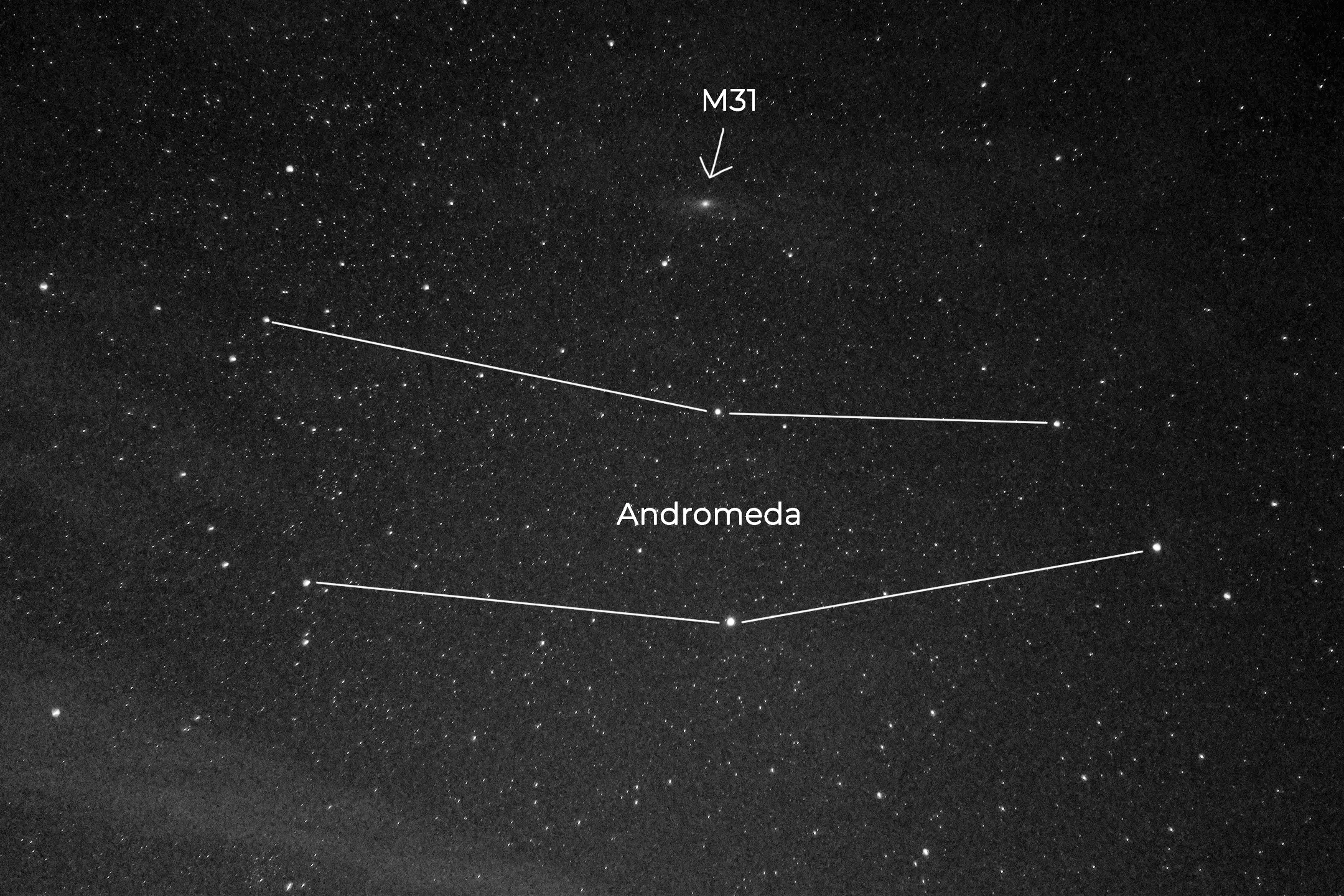
Picture taken with a DSLR-camera from a camping trip on Sherkin Island looking towards the east.
One of the most generous things my father did for me was showing me all the star constellations of the Northern hemisphere. After a while, this skill morphed into a bit of an elitist attitude where I asked astrology people if they had actually seen the zodiacs or planets they were talking about.
In any case, I’ve calmed down about this more lately – people are doing far, far, far worse things than astrological fortune telling. However, one thing my father didn’t show me was the Messier object 31, also known as the Andromeda Galaxy.
In retrospect, I may have looked at it without knowing so, since spotting Andromeda is easy enough. She’s tied to Pegasus and right below Cassiopeia (Andromeda’s mother), while making an iconic tapering shape to the right. Though she’s her own mythological person, on the nightsky, Andromeda looks very much like the bushy tail of Pegasus. However, the Andromeda galaxy is harder to spot, unless it’s dark enough.
Despite being referred to as an object, a galaxy is a spiralling cluster of many, many, many stars. The Andromeda Galaxy is in fact the closest galaxy to ours (the Milky Way) and one of the furthest things* you can see with your unaided eyeballs. After finally spotting it on a camping trip, I had one of those fuck-me-this-is-ridiculous kind of experiences.
While I don’t currently have the equipment to capture a high-resolution picture that shows all the associated minor galaxies and interstellar clouds, this will do for now.
And also, go see it for yourself!
* The galaxy is about 2.5 million light years away, which is VERY roughly 24,000,000,000,000,000,000 kilometres, which in turn is like completing a loop around Earth hundreds of trillions of times.

References: