A grand knight
Geology nugget

Earlier this year, my friend Hasti sent these videos from the flanks of the Fuego volcano in Guatemala. A long way from Bandon in County Cork for sure.
A great secret lie under Bandon. A dormant body with its unearthed remains scattered in streams, fields and forests of the local landscape.
And so, a bit of detective began.
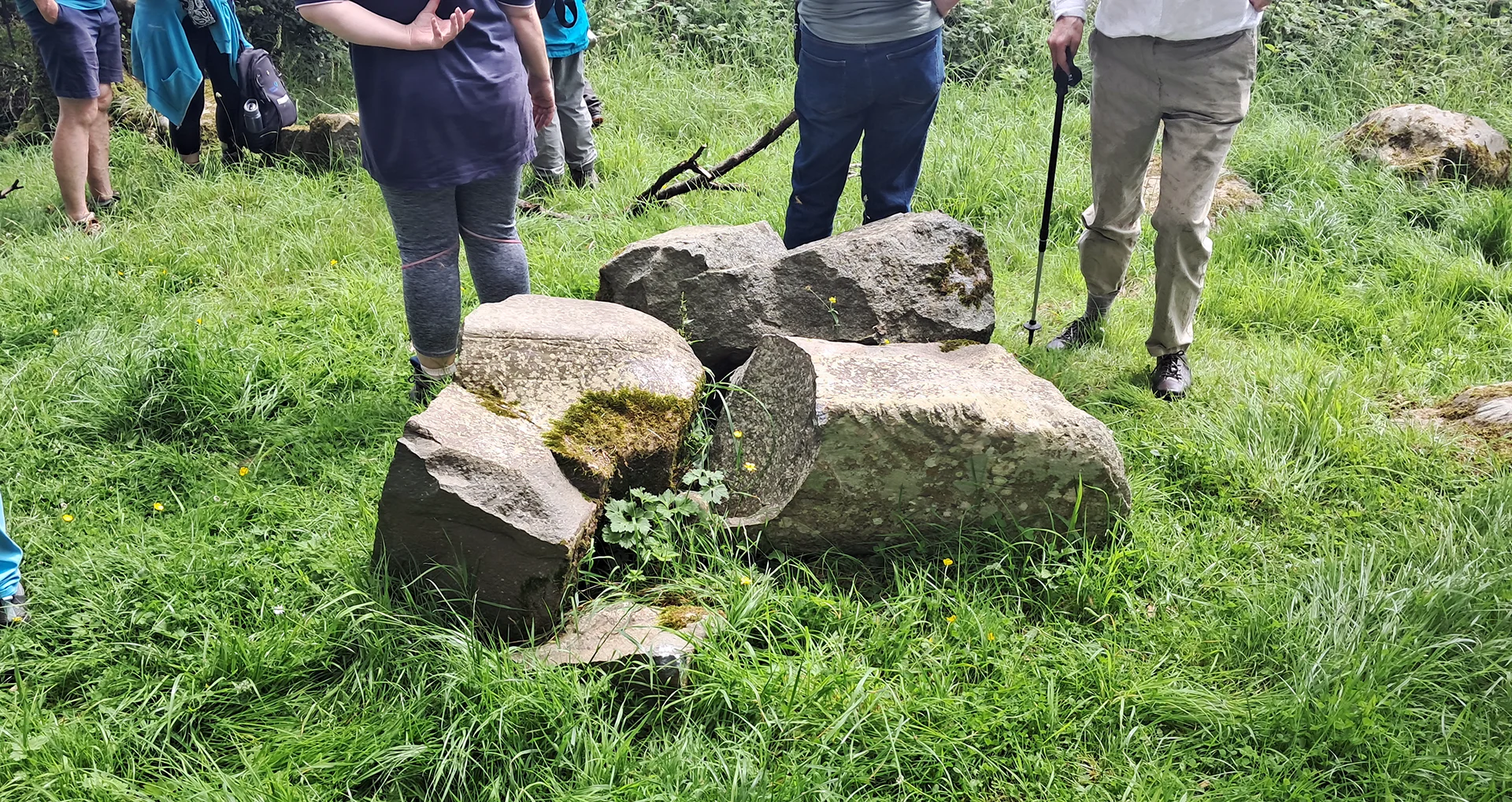
I know, I know. It may not look exciting at first, but these are remains from rocks that were once over 1000°C. The photo was taken a bit north of Bandon in County Cork.
Unlike in counties Kerry and Waterford, there aren’t many signs of volcanic activity in the mapped bedrock of County Cork. And so, the records of an extensive rock unit of gabbro near Bandon are almost anomalous.
When I first looked at a geological map of cork and saw a snake-like feature a kilometre or so north of the Cork town of Bandon, I asked an adult (an expert). Very few had looked at it in recent times and it was almost a bit of a mythological tale.
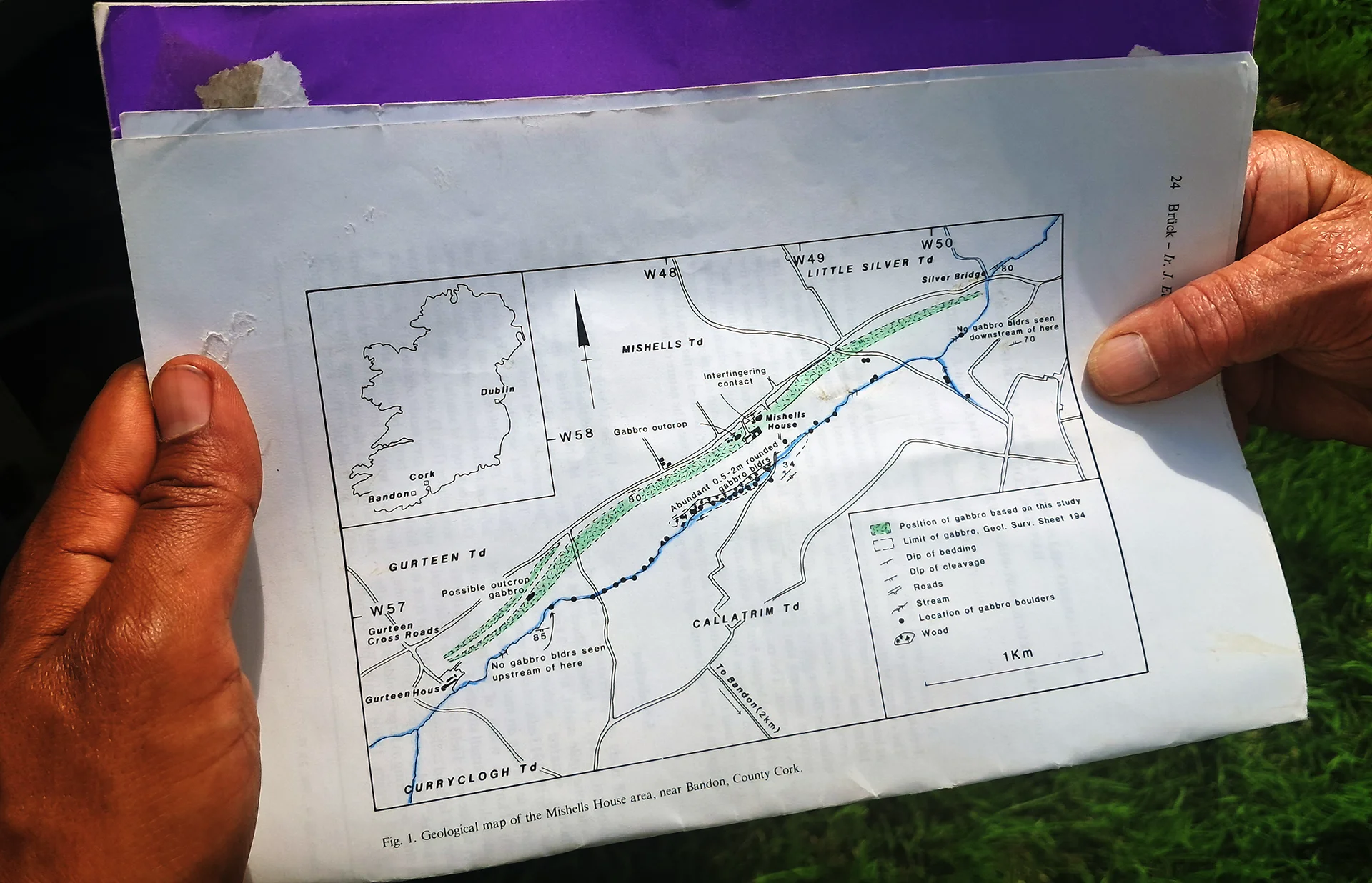
One thing is looking at a geological outcrop on a map, another thing is finding it in the field. Typically, someone would’ve found actual rocks in the field, then later geophysical measurements would help complete the boundary.
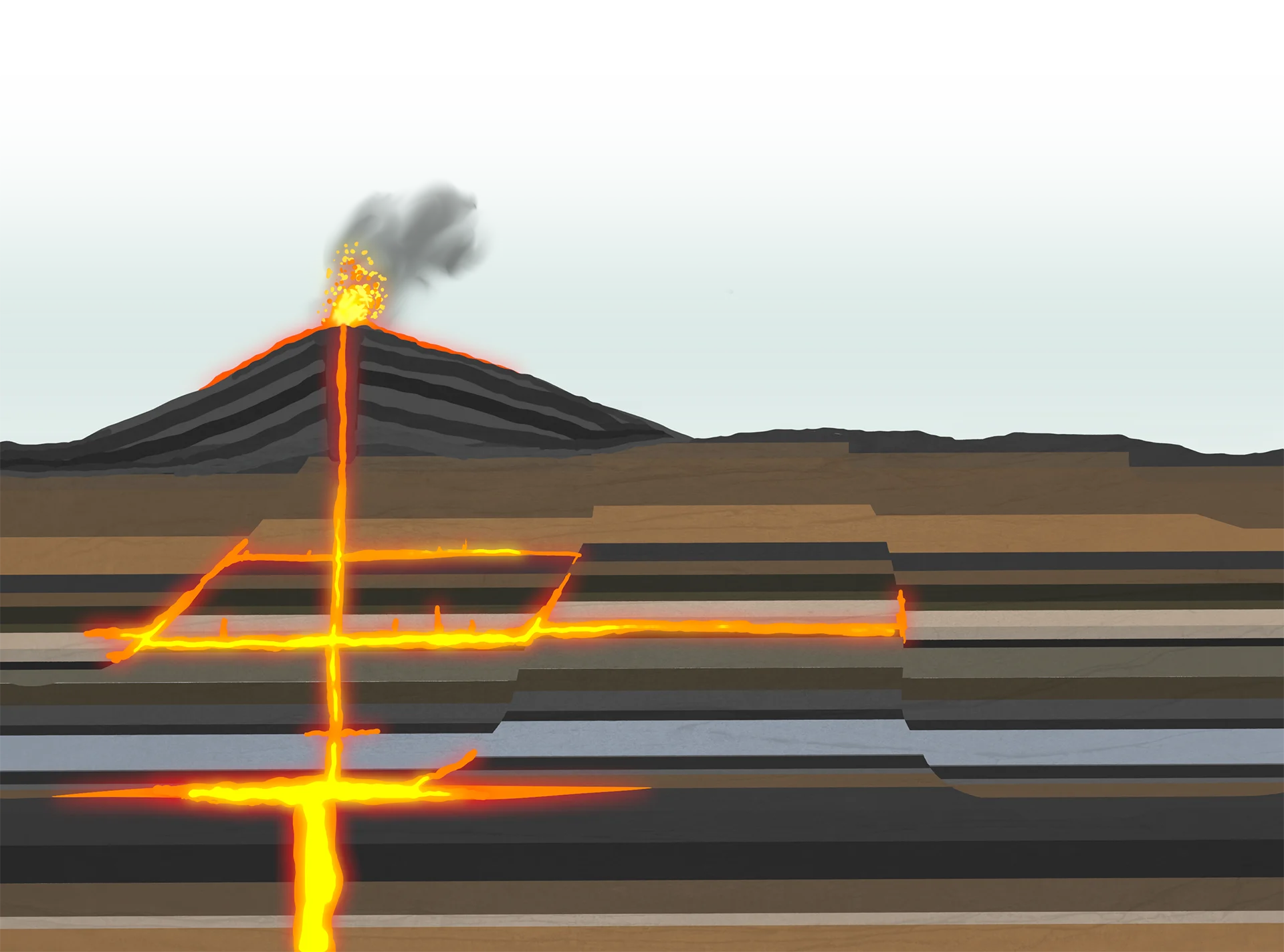
I illustrated this generalised schematic showing magma moving up through the layers of the crust. All of these arms of magma can be referred to as intrusions. As you can see, not all intrusions reach the surface to become volcanoes.
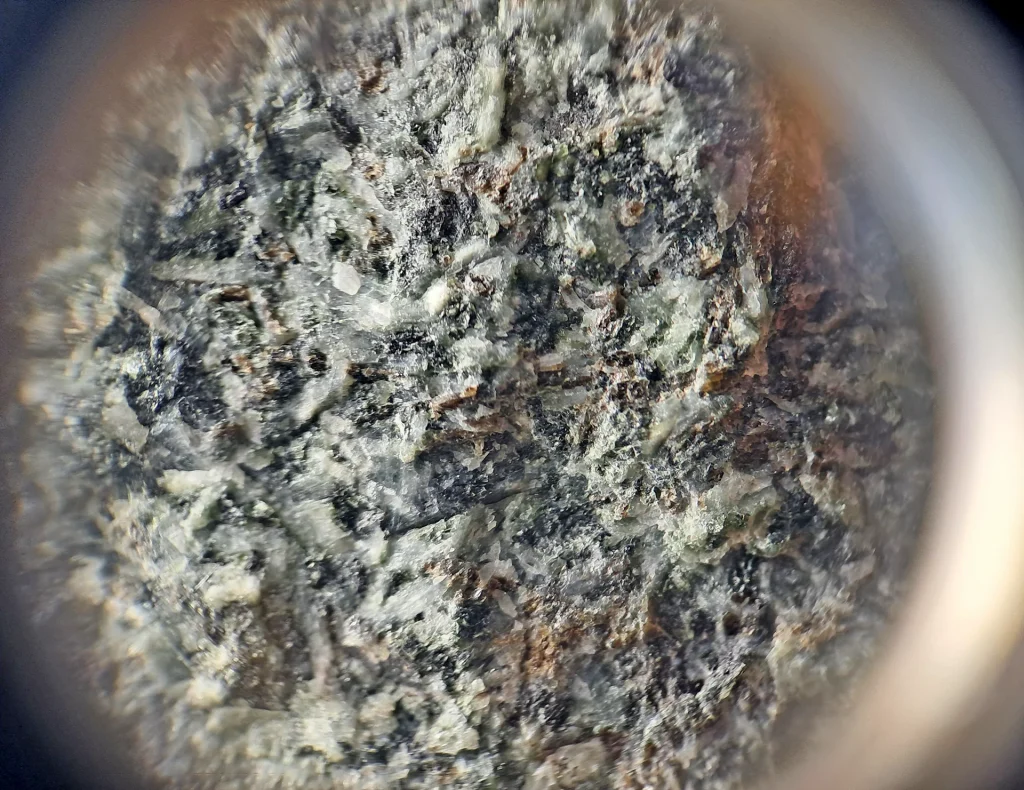
White elongated minerals here are feldspar crystals. At higher temperatures, when the rock was molten, calcium-rich feldspars like plagioclase would’ve formed early. Depending on the chemistry of the magma, these feldspars could become more alkaline as the molten rock cooled.
While hard to differentiate here, the darkest of minerals here are very likely pyroxenes. As the temperature of the once molten rock would’ve lowered, pyroxenes crystallised after olivine minerals had formed.
Dark and green minerals in gabbros are often olivine. This would be the first mineral to crystallise early as the temperature of the magma decreased.
After the magma had cooled and the hard rock had formed, secondary minerals would start to alter the rock. These secondary alterations may come from erosion, exposure to fluids other factors. Red seen here could be the iron in the olivines and pyroxenes oxidising as rust.
Magnified closeup of a gabbro rock from north of Bandon. You can click the bubbles to see what the rock is made up of. The section here is about 5 millimetres across.
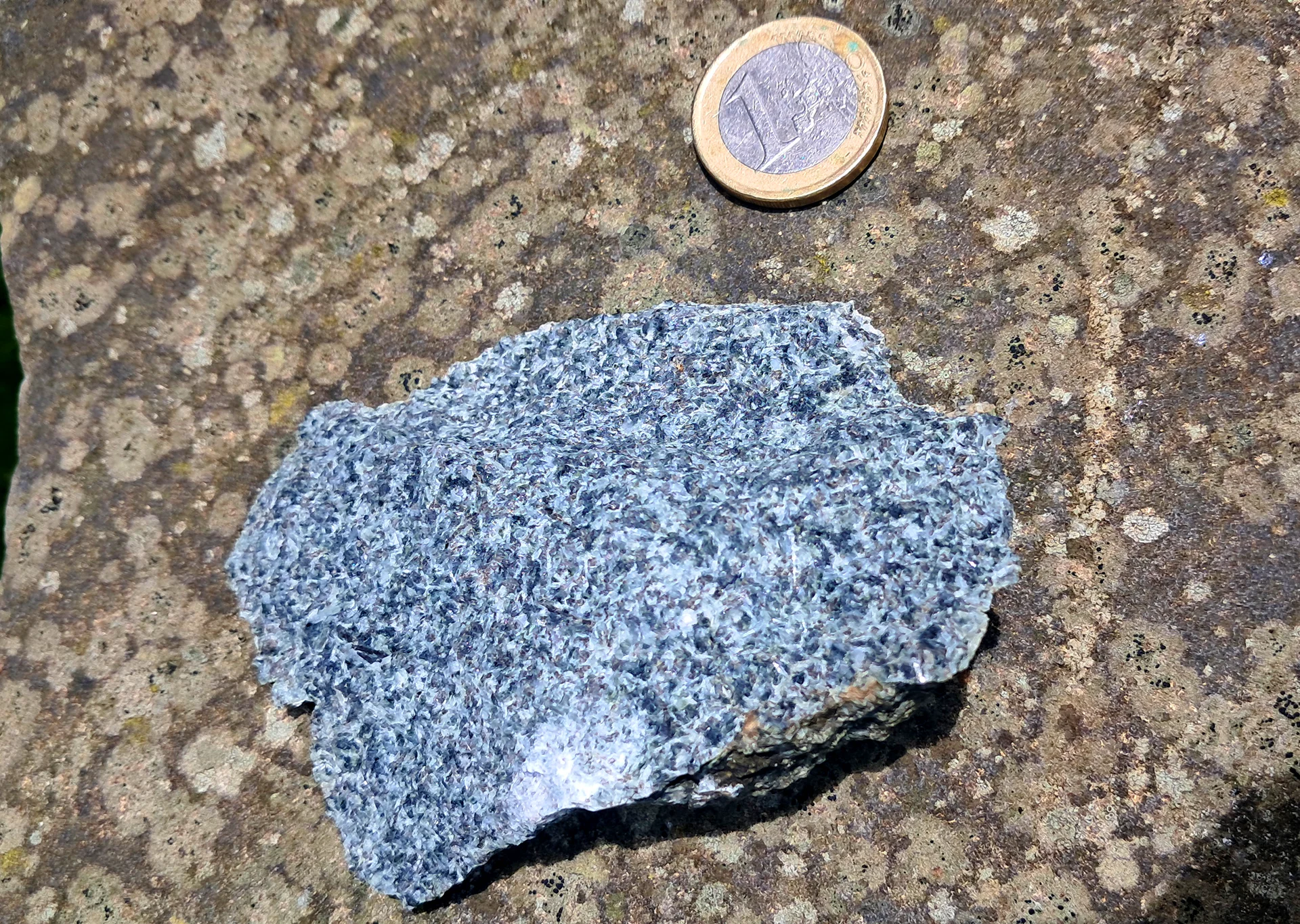
Most of Cork’s rocks is composed of Old Red Sandstone. It is thus anomalous to find a rock associated with volcanic activity in the County.
References:
Horni, J. Á., Hopper J. R., Blischke A., Geisler W. H., Stewart M., McDermott K., Judge M., Erlendsson Ö., & Árting U. 2017. Regional distribution of volcanism within the North Atlantic Igneous Province. Geological Society, London, Special Publications. Vol. 447, PP. 105 – 125. DOI: 10.1144/SP447.18
Brück, P. M., Beese, A. P., Sweetman, T. M. & Wheildon, J. 1988. Alkali Gabbro Sills in the Lower Carboniferous near Bandon, County Cork. Irish Journal of Earth Sciences, Vol. 9, No. 1, pp. 23-37. Retrieved via: https://www.jstor.org/stable/30002501
https://gsi.geodata.gov.ie/portal/apps/webappviewer/index.html?id=f1b130022e7146a7b76e1010c7efb2a9
Thomas Heising here!
I’m originally from Denmark, but now living in Cork, Ireland and working with visual science communication. You may have found this post because you were curious about this page or wanted to know more about the topic at hand – in any case: welcome.
There are more writings, visuals and videos around here about geology, the weather, our planet, Ireland, Denmark and other things that interest me.