Thomas Heising

Visual science communication
Back to the Lab

My latest obsession

Cork sightseeing
2025 | Cork, Ireland

Metasequoia

I’ve been a bit fanatical recently.
 
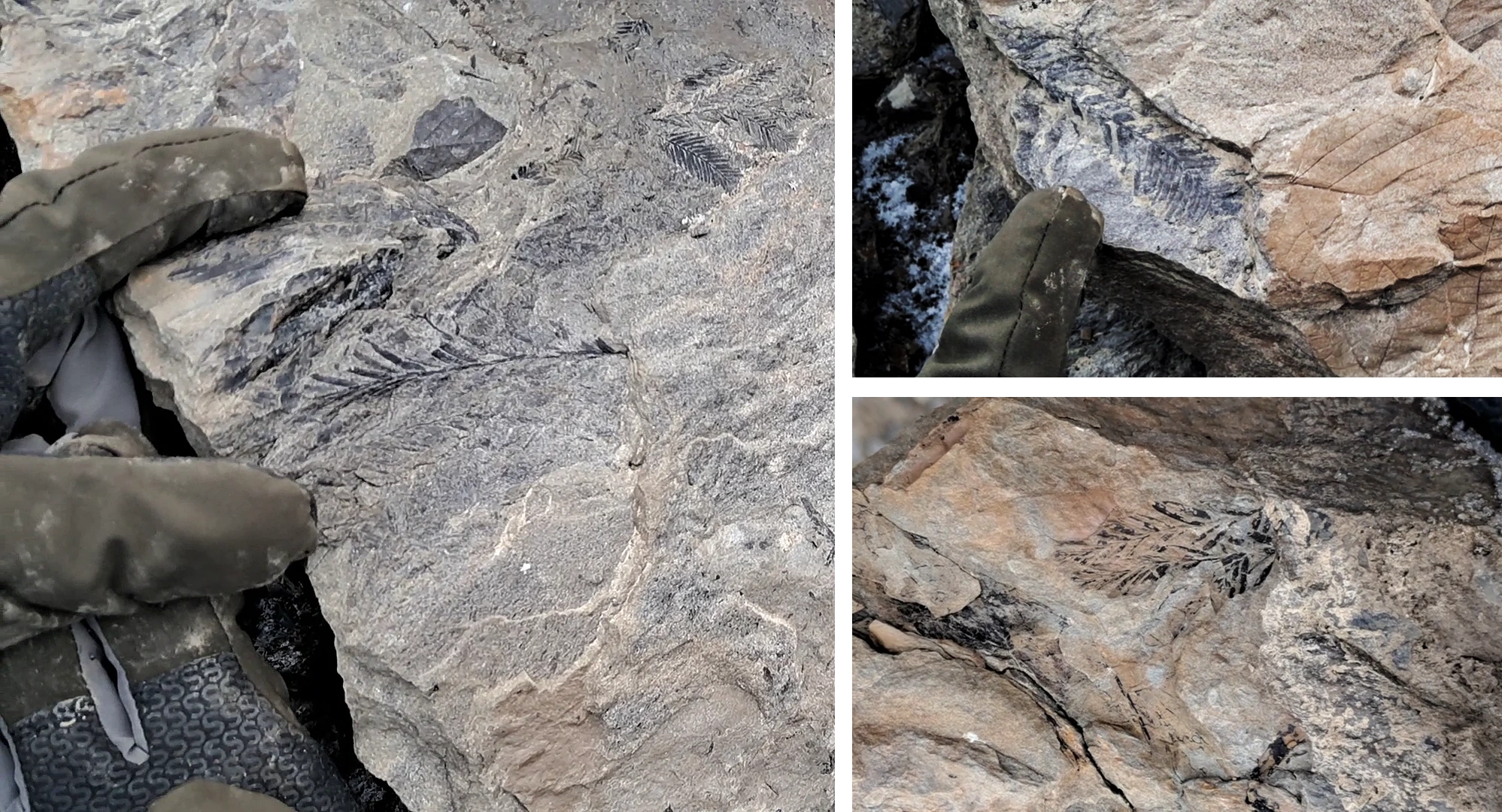
It started in 2024 with a hike on Svalbard where the route was littered with Palaeogene plant fossils. Even after 60-50 million years, the detailed prints of leaves of many plants were still vividly well-preserved. I went home and looked through various journals to identify some of these.
One name kept coming up: 
 
Metasequoia.
 
There’s a nice ring to the name, isn’t there?
 
Metasequoia-leaves were easy to identify amongst the pictures I took of the rocks and overall, quite common throughout Palaeogene-fossil assemblages on Svalbard.
 
What’s really cool is that the fossils of the plant were known and named before the actual living plant was discovered!
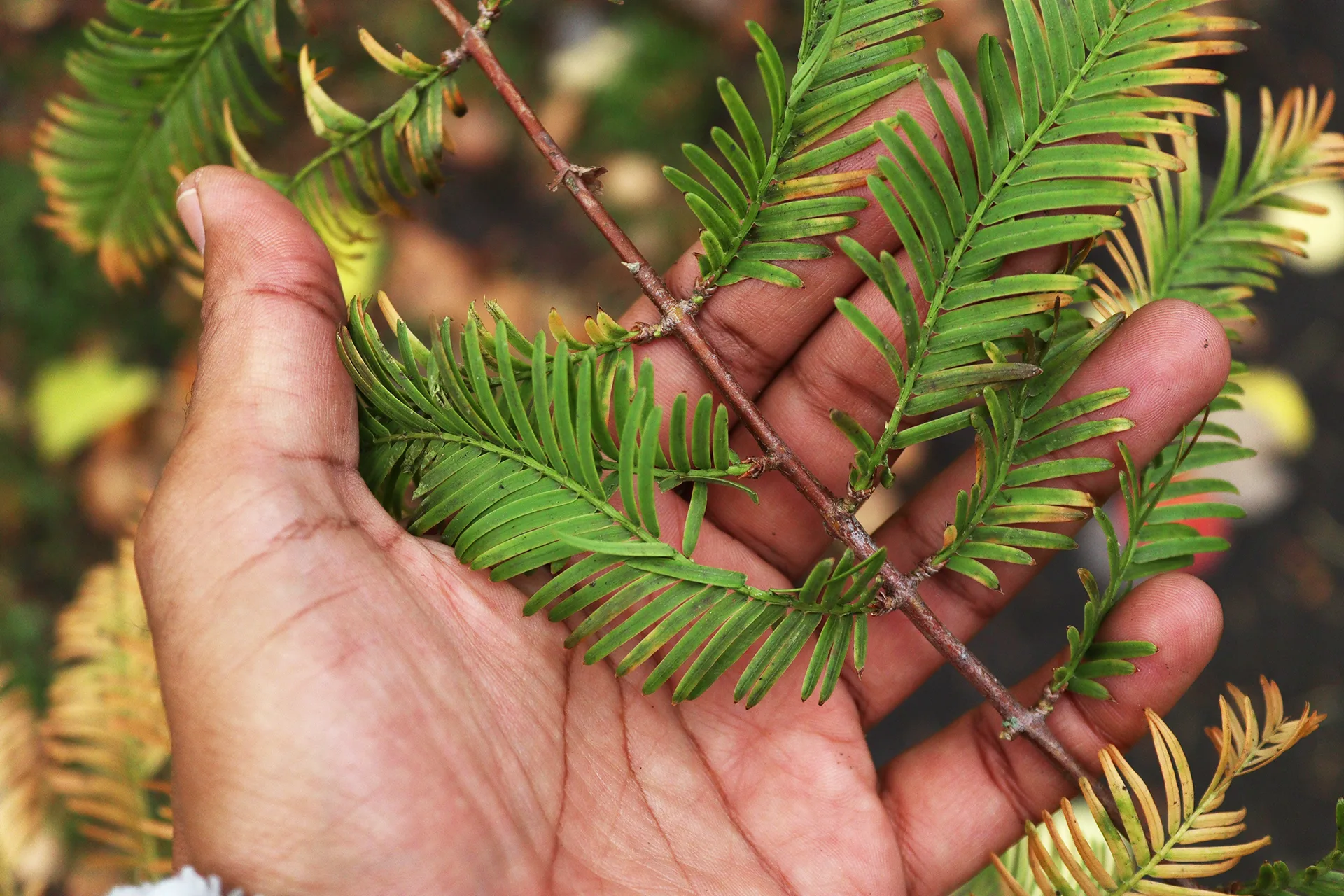
Closeup on Metasequoia leaves
Thought extinct, Metasequoia-trees were for the first time documented as alive and well in south central China back in the 1940s. Well… not well, as the single living species Metasequoia glyptostroboides is listed as an Endangered species on IUCN’s Red List of Threatened Species. That is after the tree has survived two major mass extinctions through the last 66 million years!
 
Despite its limited natural distribution, it has since been used as an ornamental plant across the world, including here in Cork city!
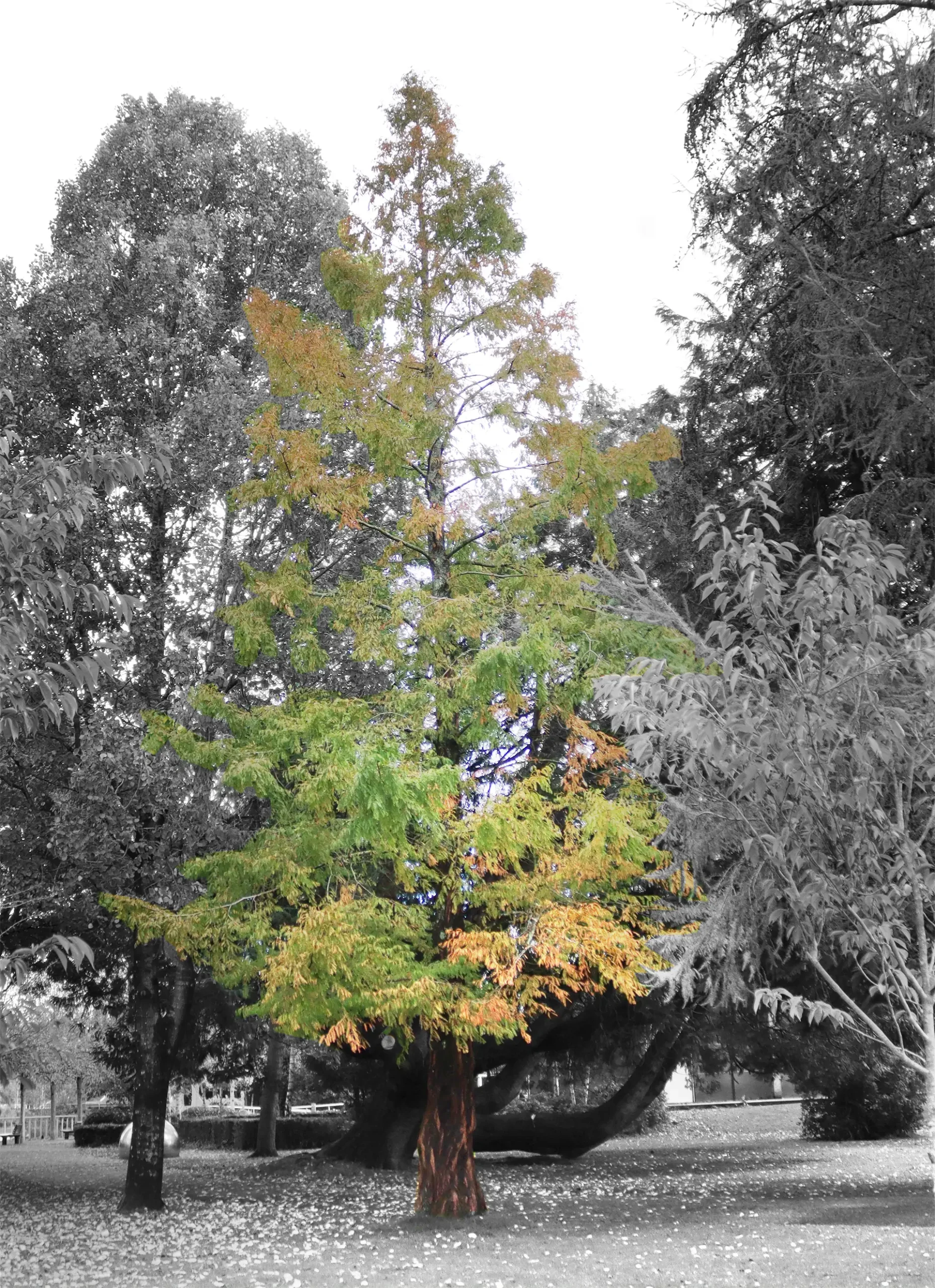
Metasequoia in Fitzgerald Park

Metasequoia in Fitzgerald Park.

Metasequoia are quite easy to identify and the name hints at how:
 
It’s a conifer tree, specifically a type of redwood. Hence in English, it is known as dawn redwood.
 
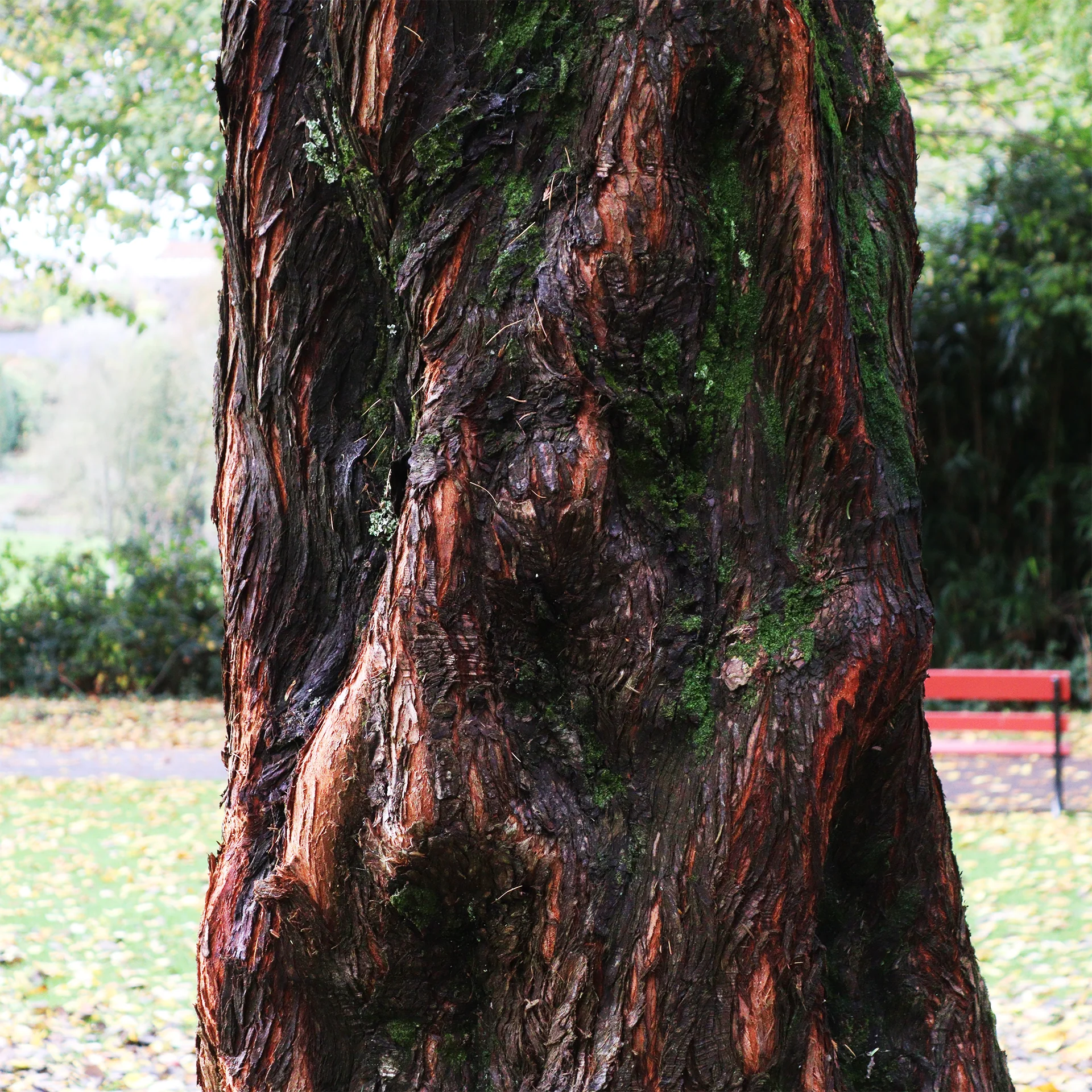
The bark looks like your typical redwood, though smaller in total size than the tree’s more famous North American counterparts: the giant redwood. From afar, the leaves look spiky like most other conifers.
 
However, touching the leaves is a different sensation than with other conifers. Metasequoia-leaves are soft and the tree is deciduous – meaning that these leaves fall off at the end of growth season.
Metasequoia trunk
Living fossil‘ is a term that gets thrown around a lot concerning plants with prehistoric lineage, but it doesn’t really make that much sense.
 
When is something NOT a living fossil? It’s hard to narrow down what applies as a ‘living fossil’ depending on whether we’re referring to families, groups or species of organisms.
 
For instance, horsetails and ferns have existed since the end of the Devonian Period, but did the exact species of horsetails or ferns, that are around today, also exist back in the Late Devonian 380 million years ago? The answer is very likely: no, they didn’t. Moreover, most plants could also be called ‘living fossils’ even if you can find fossil equivalents to them. In this case, grasses are about as old as the non-bird dinosaurs, and so, today’s thousands of grass species would have to be considered living fossils too.
 
BUT what IS remarkable is how certain plants change over geological timescales, and as in Metasequoia‘s case: how little they change over tens of millions of years.
 
These trees were widespread when non-bird dinosaurs were still around, and as studies have shown, the Metasequoia-species that grew in the presence of Tyrannosaurus and Triceratops were virtually identical to today’s Metasequoia glyptostroboides-trees!
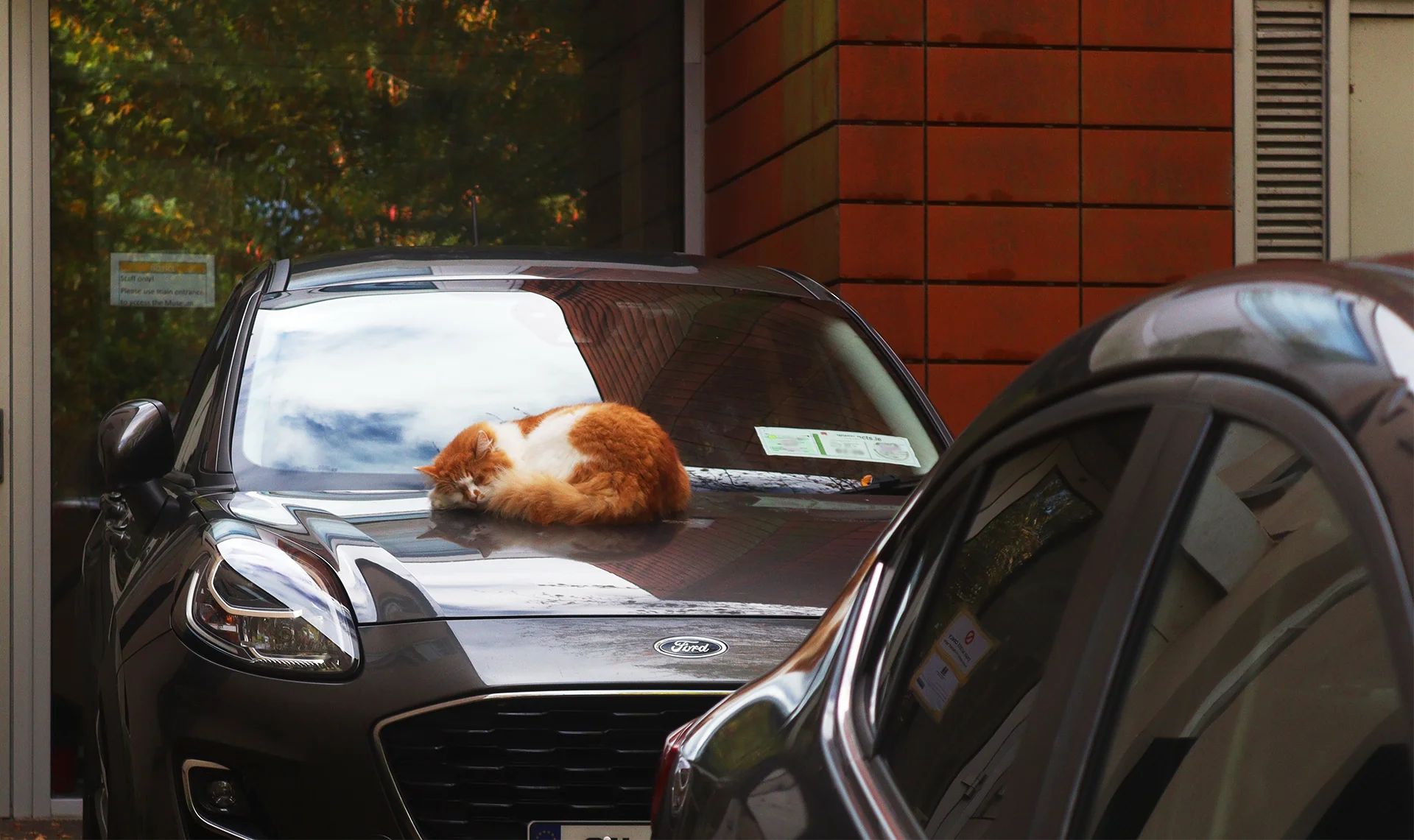
Cat in Fitzgerald Park
Autumn walks are great for the body and soothing for the head. I’ve been walking around sentimentally listening to Antonio Vivaldi, George Bizet and Scandinavian psalms during work breaks and weekends.
 
During these mini-expeditions, I spotted two public spaces with Metasequoia-trees: in Fitzgerald Park and at UCC Campus.
 
Again, while it’s a popular ornamental tree, it’s at the risk of extinction, along with many other organisms.
 
Christ above, I’m ending a lot of posts talking about extinctions, so above is a nice little scene from a recent Cork city walk.

References:

Fu F., Song C., Wen C., Yang L., Guo Y., Yang X., Shu Z., Li X., Feng Y., Liu B., Sun M., Zhong Y., Chen L., Niu Y., Chen J., Wang G., Yin T., Chen S., Xue L. & Cao F. 2023. The Metasequoia genome and evolutionary relationships among redwoods. Plant Communications. Vol. 4, Issue 6, 100643. DOI: 10.1016/j.xplc.2023.100643.

Kundu S., Hazra T., Chakraborty T., Bera S. & Khan M. A. 2023. Evidence of the oldest extant vascular plant (horsetails)
from the Indian Cenozoic. Plant Diversity, Vol. 45, Issue 5, PP. 569-589. DOI: 10.1016/j.pld.2023.01.004.

LePage B. A., Yang H. & Matsumoto M. 2005. The Geobiology and Ecology of Metasequoia. Science and Technology Book Publications.

Uhl D., Traiser, C., Griesser U. & Denk T. 2007. Fossil leaves as palaeoclimate proxies in the Palaeogene of Spitsbergen (Svalbard). Acta Palaeobotanica. Vol. 47. pp. 89-107.

https://www.iucnredlist.org/