Thomas Heising

Visual science communication
Back to the Lab

When the Arctic wasn’t arctic

Video - Geology nugget
2024 | Svalbard, Norway
Timecodes for the video:
  • 0;00: Off from Longyearbyen.
  • 0;05: Selfie.
  • 0;06: Arriving at Larsbreen.
  • 0;11: View down towards Longyearbyen.
  • 0;16: Looking up towards Nordenskiöldfjellet.
  • 0;18: Down towards Longyearbreen.
  • 0;21: Landslide!
  • 0;37: Longyearbreen.
  • 0;39: First Palaeocene plant fossils.
  • 0;46: Just to feed the imagination a bit.
  • 1;16: Walking on Longyearbreen.
The term ‘Arctic’ refers to the cold region around the North Pole, but also to anything cold in general.
A few slices of rock wonders from Svalbard!
So, a friend and I went on a guided hike from Longyearbyen in Svalbard up to the nearby Sarkofagen. The guide, a cool Italian guy, did an excellent job highlighting and explaining features and glacial processes that had shaped the landscape around us. Also, I love when a group of strangers get together in awkward silence, and by the end of the experience, everyone’s chatting and empathetic.
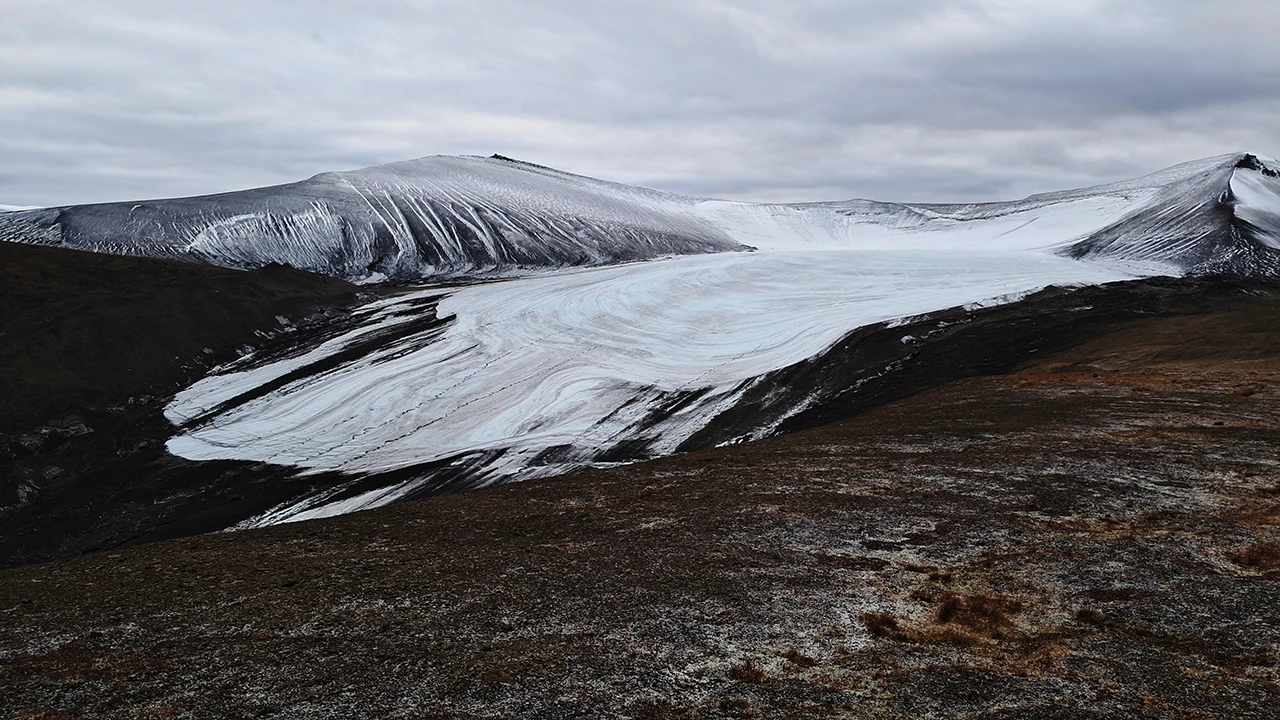
Looking towards Larsbreen
Since I was asked so kindly...
As soon as it was discovered I was a geologist, I got a minute or two of talking as well. My knowledge of Svalbard was limited, but knowing that we were surrounded by Palaeogene-rocks (will explain!), I could say a bit about the conditions during that time, moreover mention a few principles on how landscapes are formed over millions of years.
 
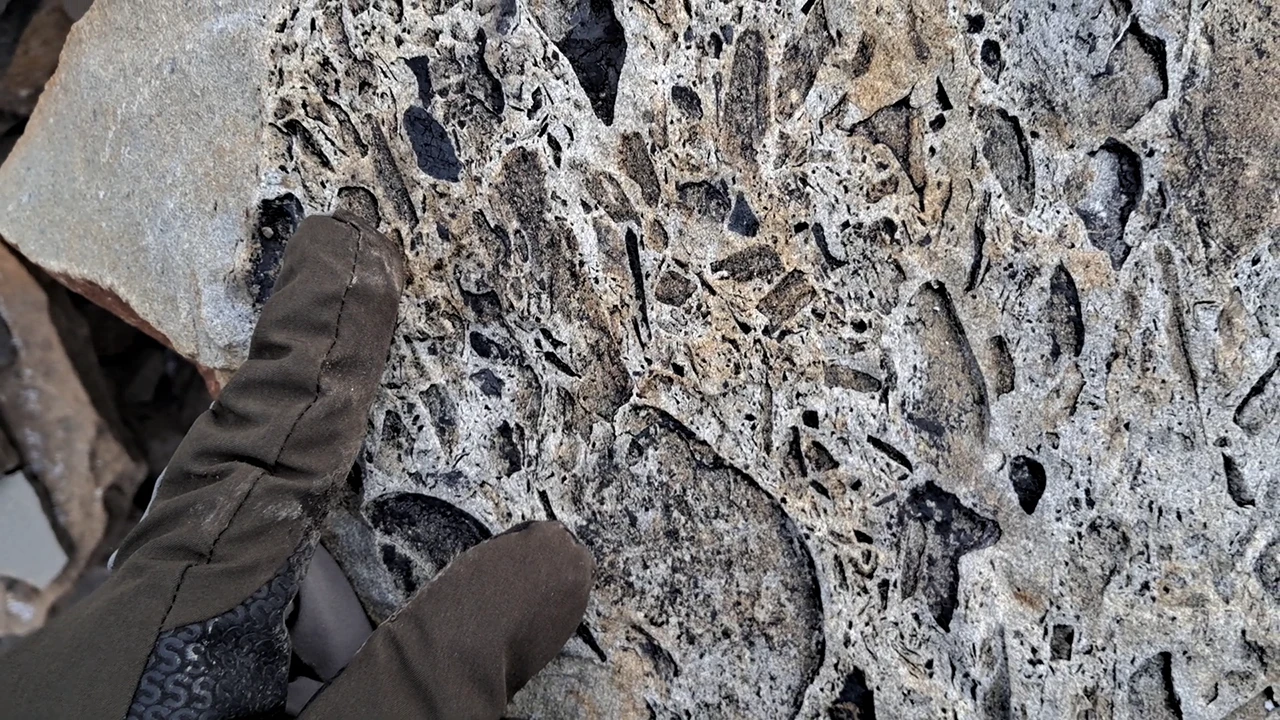
On the way down from Sarkofagen, we finally started to see what I’d been so excited about seeing: plant fossils! And they were even more impressive than I expected.
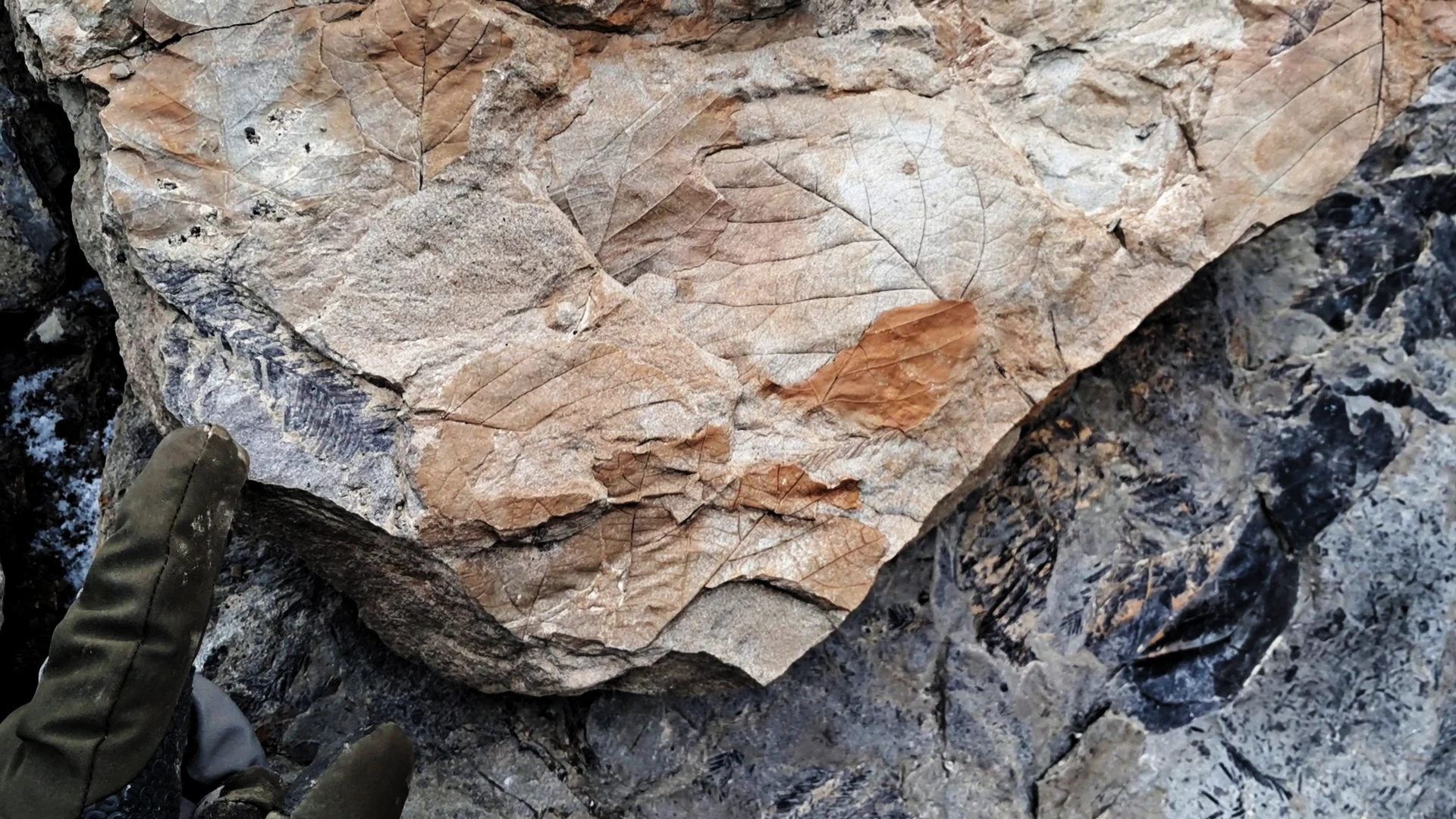
Palaeogene plant fossils in Firkanten Formation with metasequoia
I wish I was a botanist. Just for an hour or two
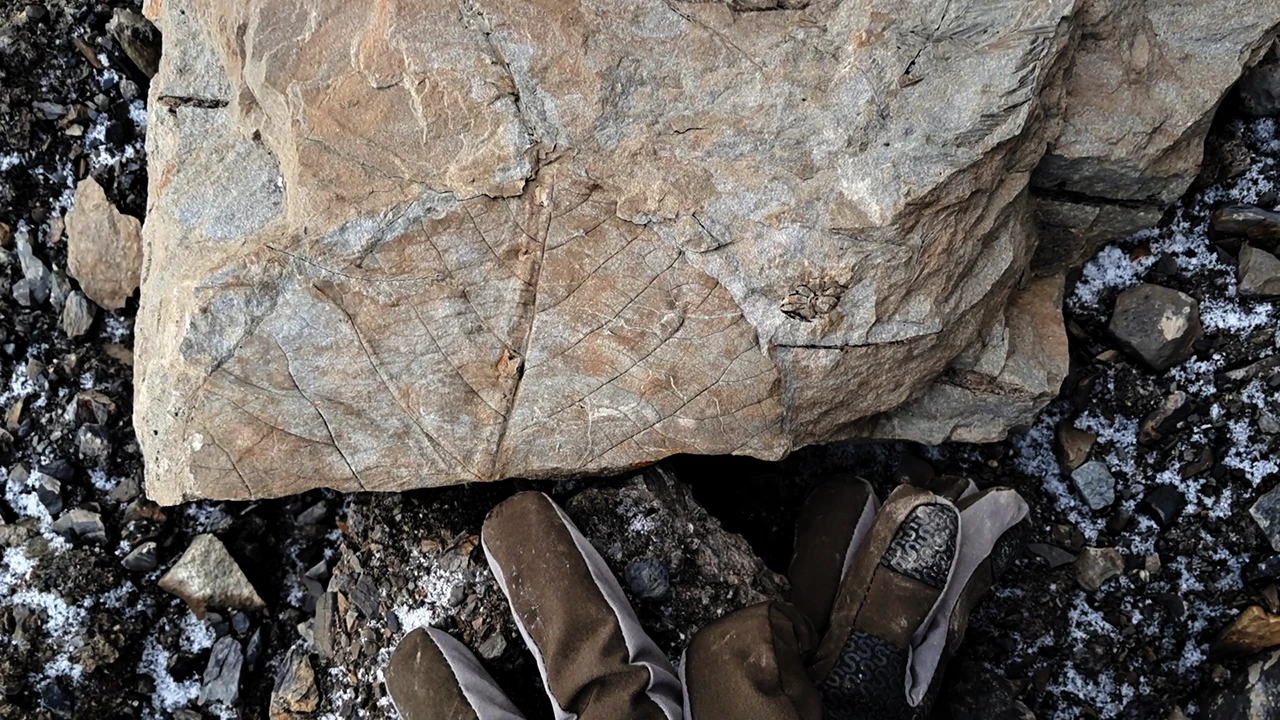
Here, fossils of leaves, stilks and branches are strewn across the rock faces. Immaculate in detail and with so much to tell! Geology relies on other fields such as biology and physics to understand the current world better, so that we can in turn understand the past better. There’s a bit of detective work to it, and the rock formation itself is the crime scene.
 
The leaf sizes here can tell us a few things about “Svalbard” about 50 million years ago. For instance, many of these plant fossils had about 10 cm wide broad-leaves on them. 
 
Studies from botany have shown that there’s a good correlation between leaf size, precipitation and temperature: larger leaves hint at warmer climate and more rainfall. The opposite is now the case for Svalbard’s plant life today, but back then, there would’ve been warm enough conditions for large broad-leaved trees. This is despite the area being close to the North Pole back then too.
Palaeogene plant fossils in Firkanten Formation
Then versus now
Today Svalbard doesn’t have any trees. It’s simply too cold for them to grow and to penetrate the ground. And so, the tallest organisms on Svalbard are mammals! But it wasn’t always like that.
 
In another post, I talked about staring into a geological layer from the end of the Cretaceous Period 66 million years ago when the reign of the dinosaurs ended. The geological time period that followed the Cretaceous was the Palaeogene. This is the time that the lush forests of Svalbard were growing.
 
Now this is where things become a bit confusing and understandably so. If you don’t care about systematic details and conventions, then avoid the rest of this page!
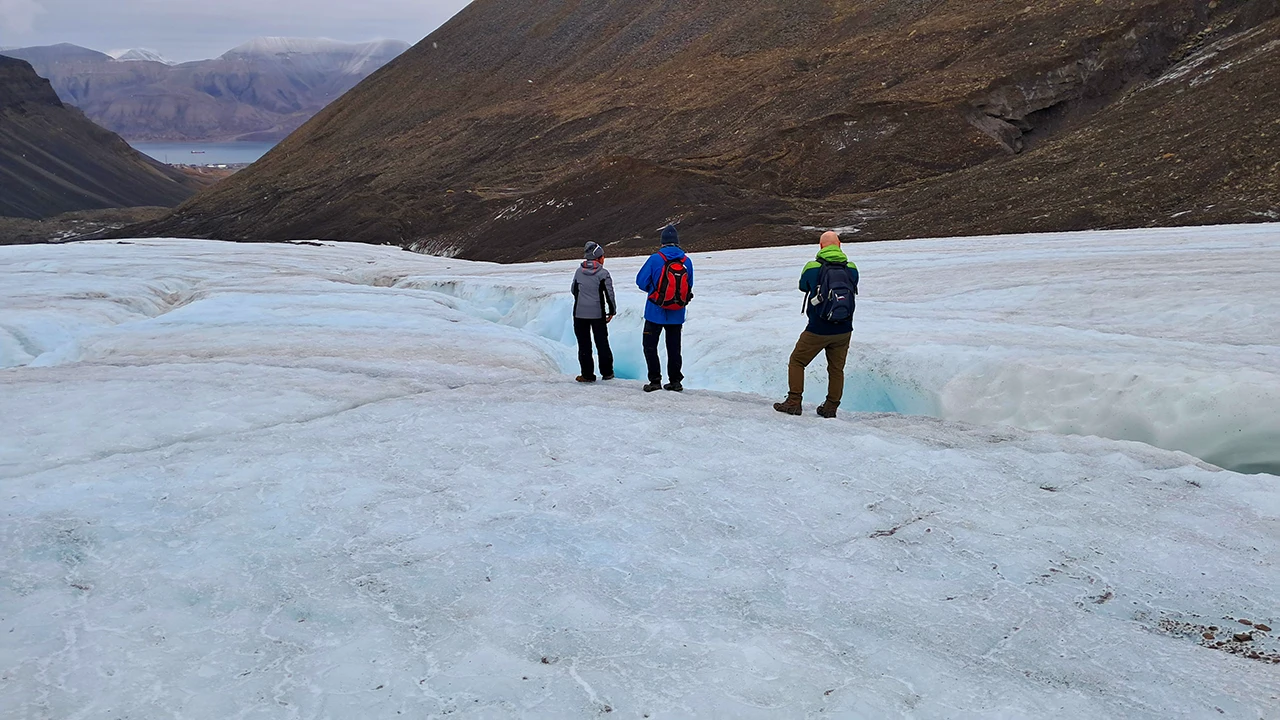
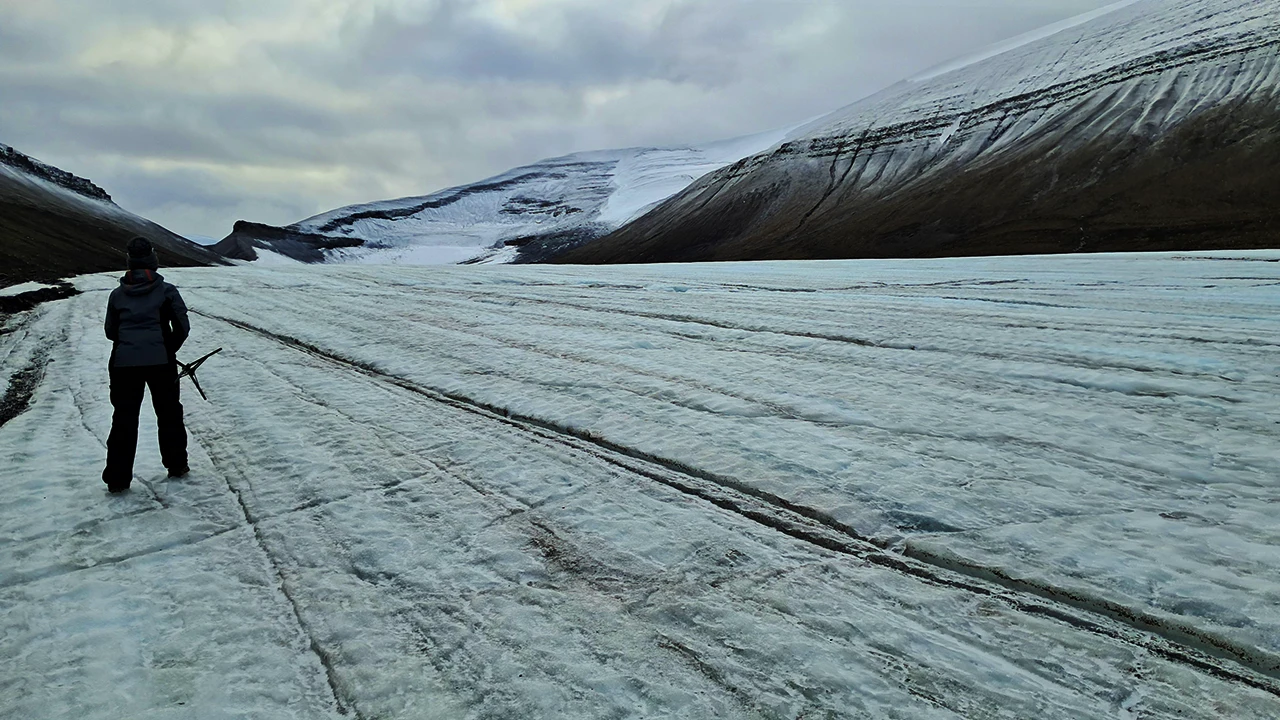
On the Longyear Glacier
The confusion about time periods
Just like we’ve named periods in human history like the Middle Ages, Romanticism, Renaissance etc., geologists have also given long stretches of time in Earth’s history names and limited these within specific ages. For instance, the Cretaceous Period is defined as lasting from 143.1 million years ago to 66 million years ago. As with any time period (obviously except the one you’re living in), another time period will follow. The Palaeogene is the time period that follows the Cretaceous.
 
NOTE that these are specifically “periods“. Now to complicate matters, but also to help us put time and events into systems, periods are further subdivided into “epochs“.
 
While many people know the Jurassic and Cretaceous periods from Hollywood-movies, I can’t think of an epoch that is well-known in pop culture. And yet, there are so many epochs!
Palaeogene plant fossils in Firkanten Formation
One letter makes the difference
And as such, the Palaeogene Period which lasts from 66 million years ago to 23.04 million years ago is divided into three epochs: Palaeocene, Eocene and Oligocene. Annoyingly, some scholars decided to give the Palaeogene Period and Palaeocene Epoch near-identical names…
 
In any case, the Palaeocene Epoch starts right after all the non-bird dinosaurs went extinct. The rocks and fossils from Svalbard are from forests that grew during this time when the global order of life had been completely jolted. 
 
These fossil and coal-bearing rock layers are known scientifically as Firkanten Formation (the Quadrant or Quadrilateral Formation) and the fossils here are amazingly preserved as shown above! These are important because they tell us that about 60 million years ago, the climate on our planet was warmer. Svalbard was still close enough to the North Pole back then, but the massive ice sheets we see today weren’t there at the time.
 
Again, today trees can’t even grow on Svalbard meaning that the tallest vegetation is only a few centimetres in height.
 
How times change.
Nordenskiöldtoppen in the distance
Somewhere up there are the signs of a mass extinction.
Oh yes, and mass extinctions...
One last thing! The mountain in the distance seen on image above is Nordenskiöldtoppen and it follows the western edge of the glacier Longyearbreen.
 
So, the rock layers of Firkanten Formation are the oldest of the Palaeogene-layers in the area we hiked in, and these get younger as you move upwards while climbing Nordenskiöldtoppen. Eventually, one gets to the boundary between two epochs: the Palaeocene Epoch and the Eocene Epoch. This very boundary marks a mass extinction!
 
That’s right, yeah. Only 10 million years after an asteroid wiped out all the non-bird dinosaurs, life on Earth was to be tortured and suffocated by another calamity.
 
This mass extinction is called the Palaeocene-Eocene Thermal Maximum, because it was quite warm back then. There’s not yet full agreement on what happened 56 million years ago, but it likely had something to do with some enormous volcanic eruptions happening at the time.
 
And this boundary is exposed along the sides of Nordenskiöldtoppen. I’m not going back to Svalbard for it though. There are other places in Europe where this boundary is exposed.

References:

https://geokart.npolar.no/

Dypvik H., Riber L., Burca F., Rüther D., Jargvoll D., Nagy J. & Jochmann M. 2011. The Paleocene–Eocene thermal maximum (PETM) in Svalbard — clay mineral and geochemical signals. Palaeogeography, Palaeoclimatology, Palaeoecology. Vol. 302, Issues 3–4. pp. 156-169. ISSN 0031-0182. DOI: 10.1016/j.palaeo.2010.12.025.

Li Y., Zou D., Shrestha N., Xu X., Wang Q., Jia W. & Wang Z. 2020. Spatiotemporal variation in leaf size and shape in response to climate. Journal of Plant Ecology. Vol 13, Issue 1. pp. 87–96. DOI: 10.1093/jpe/rtz053

Nagy J. 2005. Delta-influenced foraminiferal facies and sequence stratigraphy of Paleocene deposits in Spitsbergen. Palaeogeography, Palaeoclimatology, Palaeoecology. Vol. 222, Issues 1–2, pp. 161-179.
ISSN 0031-0182, DOI: 10.1016/j.palaeo.2005.03.014.

Tierney J.E., Zhu J., Li M., Ridgwell A., Hakim G.J., Poulsen C.J., Whiteford R.D.M., Rae J.W.B., & Kump L.R. 2022. Spatial patterns of climate change across the Paleocene–Eocene Thermal Maximum. Proc. Natl. Acad. Sci. U.S.A. Vol. 119 (42) e2205326119. DOI: 10.1073/pnas.2205326119

Uhl D., Traiser C., Griesser U. & Denk T. 2007. Fossil leaves as palaeoclimate proxies in the Palaeogene of Spitsbergen (Svalbard). Acta Palaeobotanica. Vol. 47. pp. 89-107.